Sun > Earth = Abundance

Between 1927 and 1983, the architect and philosopher Buckminster Fuller wrote and spoke often about the logic of a cumulative and self-accelerating ephemeralization of the products of all encounters between human knowledge and technology. As Fuller explained in his book Critical Path, when Magellan’s crew completed the first maritime circumnavigation of the globe, the journey had taken 2 years; when the first steam ship did it, it took 2 months, the first airplane 2 weeks and the first orbiting space capsule 2 days. We are now a lot faster on all fronts.

Continue Reading

8 Steps to Fuel Free Sustainable Democracy

We can build a 100% fuel free full-spectrum sustainable democracy.

With 8 conceptually simple, and practically far-reaching framework upgrades, we can accelerate the pace of change and motivate a paradigm shift in the way we address climate destabilization, without any command-and-control or dubious financial wizardry:

  1. Full-spectrum sustainable communities (FSSC)
  2. Calculation of climate debt amassed to date
  3. Focus on speeding over the horizon tech to market
  4. Smart grid
  5. Solar highway infrastructure
  6. Maximum flexibility in clean fuel choice
  7. Grassroots-capacitative Fuel Free Media Network
  8. Citizen leadership on federal policy-making

Continue Reading

Pope Francis: Reformer, Democrat, Revolutionary or Old Guard?

On the evening of March 13, 2013, a narrow column of white smoke rose from a chimney above the Sistine Chapel, in Vatican City. The College of Cardinals had just chosen one of their own—a Jesuit from Buenos Aires, Cardinal Jorge Bergoglio—to become Pope Francis, the first Catholic leader to adopt the name of the patron saint of peace and of the poor.

There are hopes the first Latin American Pope, having adopted the name of Francis, will be a reformer who opens the church and who will seek to mobilize 1.2 billion Catholics worldwide to drive a transition to a period of greater fairness in economics and in politics. As the world’s population continues to expand toward 8 billion, socio-economic disparities are expanding on every continent.

Continue Reading

Answers for Crafting National Carbon Pricing Plan

There is a new bicameral Carbon Fee coalition in the House and Senate. The coalition is led by Rep. Waxman, Sen. Whitehouse, Rep. Blumenauer, Sen. Schatz & their respective staff, and they are asking for public comment.

Here are the four questions upon which the legislators are seeking particular guidance:

  1. What is the appropriate price per ton for polluters to pay? The draft contains alternative prices of $15, $25, and $35 per ton for discussion purposes.
  2. How much should the price per ton increase on an annual basis? The draft contains a range of increases from 2% to 8% per year for discussion purposes.
  3. What are the best ways to return the revenue to the American people? The discussion draft proposes putting the revenue toward the following goals, and solicits comments on how to best accomplish each: (1) mitigating energy costs for consumers, especially low-income consumers; (2) reducing the Federal deficit; (3) protecting jobs of workers at trade-vulnerable, energy intensive industries; (4) reducing the tax liability for individuals and businesses; and (5) investing in other activities to reduce carbon pollution and its effects.
  4. How should the carbon fee program interact with state programs that address carbon pollution?

Continue Reading

Ill-advised Austerity to Sweep through American Economy

Austerity means more than reducing budgets or trimming around the edges; it means making services that are standard scarce and directly impacting citizens’ quality of life. And at 11:59 pm Friday, March 1, 2013, austerity came to the United States. The legislation requiring budget sequestration will force 9% cuts to every project of every office of every program of every agency within the federal government. No one will be spared; no consideration will be given for human need or impact on quality, health or long-term solvency.

We know from the European experience that austerity brings recession. The UK has had three since 2008. The Greek economy is in a spiraling nosedive. Spain’s austerity measures have pushed unemployment past 50% for young people. There is a reason for this: when coffers are strained because the economy is growing slowly or not at all, cuts to government spending deprive people in society of money, and that slows economic activity. It also leaves more people without work, which further strains budgets.

To avoid mass public-sector unemployment, sequestration will be achieved in part through furlough: reducing days worked and eliminating pay for the time not worked. This is, we are told, the best that can be done to prevent the worst of the worst: a ripple effect of degradations that would include mass layoffs, home foreclosures, and put even more communities under sustained, pervasive economic strain.

It is difficult to overstate the point: fiscal austerity means that government uses its immense spending power to remove huge sums of money from circulation. This takes money out of people’s pockets, makes paying bills harder, makes buying luxury goods a gamble, and so puts the brakes on overall economic output. Absent some sort of counterbalance, the consequent economic degradation can permeate an entire marketplace, undermining whole communities and slowing the wider recovery.

That is what we know. What we don’t know is what happens when this malaise is spread evenly, everywhere. It has never been done quite this way before. When another version of sequestration was attempted, in the 1980s, last-minute deals and clever budget planning allowed policy makers to dampen the blow and essentially to prevent the cuts. The current legislation was designed to prevent such manipulations, and so to force a compromise.

We never got the compromise, and so now we must live with 9% cuts to federal spending, everywhere, at virtually the same time. Here, it may be instructive to remind ourselves that in the fourth quarter of 2008, as the financial collapse deepened, the US economy shank by 8.9%. That was a lot, and it was enough to be felt directly, in people’s family budgets. Such a decline is felt quickly and over a wide area.

The federal budget accounts for somewhere between 22% and 25% of GDP, depending on a number of factors. This means that a 9% reduction in federal spending will shear more than 2% off our national economic output—at a time when banks are still getting back their sea legs, with respect to lending (after a five-year hiatus) and unemployment figures wobble uncomfortably close to stagnation (possible connection there?).

Such a decline may not sound like much, but that is just what we know will be mathematically guaranteed to occur. If such a decline does occur, however, there will be ramifications across the entire landscape of economic activity. Investors in the US and abroad will lose confidence, and money will become tighter. That is precisely when banks feel themselves less willing to lend.

As early as 2007, even before the financial crisis exploded across the world economy, lending institutions were finding it harder to support the capital requirements for new lending. Since then, most major banks have struggled to find a way out of the arithmetic of the collapse. There was not enough wealth in the human-scale economy to support the projected future revenues to which the banks were aspiring, and on which they hoped to base their future operations.

What that means now is that a direct blow to the banks’ ability to imagine a way out of this arithmetical shortcoming will stanch the flow of capital to the Main Street economy. The United States is a consumer-driven marketplace of capital exchange, and so an impediment to the flow of capital through the hands of the people who live and work in that Main Street economy will affect the layered economic dynamics on which sustainable growth must be built.

In short: a 2-3% reduction in GDP, imposed on the marketplace by lawmakers, will ripple through the economy, reducing household wealth, increasing the cost burden on families and small businesses, and force an expansion of that decline. The contraction can be two to three times worse than the amount plotted in the sequester legislation. And this is happening with gasoline prices at $4/gallon in some places and power companies charging inexplicably high prices in some metropolitan areas.

So, a thought or two for members of Congress:

  • Like it or not, you have an obligation to not do harm through your legislative praxis;
  • You can use this opportunity (not to slash spending across the board, but) to redirect spending to more generative activities—like education, clean energy and advanced job training;
  • You should consider the potential long-term value of redirecting controversial and/or superfluous defense contract spending to home mortgage repair and refinancing;
  • The right choices right now will keep our communities whole and build a prosperous future;
  • The wrong choices (including inertia) right now will erode the value-base on which we expect families and small businesses to build a prosperous future.

We are at one of those crucial moments where the temptation to “let the process run its course”, which in the sequester legislation is akin to letting brute force win the day, is an abdication of responsibility. Democrats and Republicans, liberals and conservatives, advocates of laissez-faire and union leaders, all need to come together, be honest, and find the workable center. This is, after all, everybody’s democracy.

We are Citizens; the Time is Now

In the first State of the Union address of his second term as president of the United States, Barack Obama outlined an ambitious agenda, to reform economic and social policy, education, immigration, energy, gun control laws, and laws governing gender equality. He laid down the most direct and explicit challenge to lawmakers on climate policy, saying “If Congress won’t act soon to protect future generations, I will.”

The Congress has a choice on climate policy: comprehensive, market-based bipartisan policy, or an aggressive register of executive actions to tighten regulations and ensure US carbon emissions drop at the necessary rate. He called specifically for a “bipartisan market-based” approach, but left the specifics to lawmakers. Fortunately, thousands of citizens are already building political will for a bipartisan, market-based approach with none of the flaws of cap and trade. (Learn more here.)

Continue Reading

Working Together Makes Us Free: Inauguration 2013

The year is 2013. The world did not come to an end in the last month of 2012, as so many had feared. Cynicism and existential terror have not won the future. It is Martin Luther King Day, three weeks to the day after the 150th anniversary of the Emancipation Proclamation—which declared in the gravest of moments in our national history that we will be a true democracy, one day. As Barack Obama is sworn in for his second term, the nation aches with a desire for forward motion.

Thomas Jefferson wrote, in what is perhaps the most effective, action-oriented treatise on democracy, that “We hold these truths to be self-evident: that all [people] are created equal, endowed by their Creator with certain unalienable rights, that among these are Life, Liberty and the pursuit of Happiness.”

Near the start of his 2nd inaugural address, Pres. Obama said “Today we continue a never-ending journey to bridge the meaning of those words with the reality of our time, for history tells us that while those truths may be self-evident, they have never been self-executing.” He described the essence of the challenge we all face as that generational and never-ending effort “to keep safe our founding creed.”

The first truth of democracy is that all human beings are conscious spirits with a right to make decisions about their fate and the circumstances of the society in which they live. The second truth is that our life, our liberty and our pursuit of happiness, focus most intently on the intimate relationships that constitute the substance of our lived experience: family, chosen and cherished friendships, and romantic love.

The poet Marilyn Chin said in an interview in 2012 that “the bliss of eros must sooner or later be interrupted by the bad news of the world.” This, of course, is the cause of much rebellion, mistrust and conflict: I may find my corner of relative erotic, familial or community bliss, but degradations rooted elsewhere will, somehow, creep back in. We are challenged to address the failings of the social structures we inhabit.

It is then the work of our romantic, familial, community and individual selves, in the space of our democracy, to bring human souls together in a viable fabric of meaning, which can thrive and defy and make magic, even in the face of the hoax-math, illusion and tragedy, so active around the edges of the political sphere.

The fact is: that interference of the world in our affairs is also part of what it is to live in a democracy. The third truth of democracy is that it acts as a framework through which we can take a measure of collective or composite ethical conscience. What Chin calls “the cries of those less fortunate” are an existential summons to each of us.

That summons requires that we ask ourselves: Are we up to the ethical challenge of forging “a more perfect union”—an optimal commonwealth in which the benefits of democracy, however local or remote, accrue genuinely and irrevocably to all people? Are we free enough to do so? Can we be the democracy we seek, unafraid of any challenge, unwilling to cast aside any human being?

Senator Lamar Alexander, Republican of Tennessee, cited the author of Roots, Alex Haley, who said he had lived his life by six simple words: “Find the good, and praise it.” He was speaking, in this case, of the peaceful transition of power, how we recognize and honor the inauguration of a democratically elected president, without mob violence, rebellion or political disintegration.

Alexander subtly hinted at the challenge his party now faces, after four years of relentless and nearly uniform attacks on Pres. Obama and his legislative agenda. It is necessary to recognize that the inauguration of Barack Obama for a second term, and the peaceful transition of power that comes with it, are in themselves a triumph for democracy and human liberty, and so his party will need to find the true heart of their commitment to public service, praise the good in our system and in the work of this president, and collaborate constructively for the benefit of the nation.

Merly Evers-Williams, widow of Medgar Evers, asked God to bless “all those who contribute” to constructively serving the improvement and upkeep of our democracy. She added that “We ask you to grant our president the will to act courageously but cautiously when confronted by danger… to act prudently but deliberately when faced with adversity…” and to “strengthen us for the journey that lies ahead.”

Firm in his call for principled, pragmatic problem-solving that honors the dignity of all people, Pres. Obama revived his call for people in public life to see beyond the perceived boundaries of party or class, declaring that “Through blood born by lash and blood spilled by war, we have learned that no nation can survive half-slave and half-free.”

For a long time, Barack Obama’s warning that “a chorus of cynics” would tell us that achieving a “more perfect union”, rooted in the core truths of democracy, is not possible, rang all too true. For the years 2009-2012, cynics took this propaganda to a radical extreme, going as far as to suggest, at almost any opportunity, that efforts to provide for a more democratic, liberated and resilient American experience, must be an expression of “hatred” toward America, an attempt to “destroy” American families, or to “crush” the spirit of free enterprise.

Over that time, however, we have witnessed the persistence of humane imaginative patriotism, in the face of so much naked cynicism. Efforts to adjust problematic policy standards, to allow for a more democratic, liberated and resilient American experience, and to build that more perfect union, have proven to be expressions of love for America, for its history, its people and their future, attempts to empower families and breathe life into the collaborative creative spirit of enterprise that undergirds American democracy, the middle class, Main Street and the aspirations of hundreds of millions.

Pres. Obama specifically noted this element of his agenda and of American culture more broadly, saying “Our celebration of initiative and enterprise, our insistence on hard work … are constants in our character.” He added that public servants need to consider that “preserving our individual freedoms ultimately requires collective action,” a requirement that defines the meaning of their work in the sweep of American life.

The 2012 election seems to have been a national vote in favor of Robert Kennedy’s faithful admonition that “The American dream need not forever be deferred.” The people of the United States have voted for possibility, demanding that the Congress join the president in moving American democracy forward intelligently and with respect for life at the human scale.

The president’s voice nearly cracked when speaking of the “many who barely make it” in our economy. He sought to set the tone for how to address economic inequity and systematized community degradation, saying that “While the means will change, our purpose endures: a nation that rewards the efforts and determination of every single citizen.”

The president promised: “We will respond to the threat of climate change, knowing that the failure to do so would betray our children and future generations,” also noting that “The commitments we make to each other … do not sap our initiative … they free us” to be the society we hope to be. He added that we cannot afford to cede the clean energy transition to other nations, saying that achieving that position of world leadership will give meaning to our creed.

In two statements that received resounding applause, the president said that security does not require “perpetual war” and reminded members of Congress that “We cannot mistake absolutism for principle or substitute spectacle for politics.”

Taking the long view of democracy, he sought to frame the nature of pro-active social policy reform, saying “We must act knowing our victories will be only partial, and that it will be up to those who stand here four years, and forty years, and four hundred years hence,” to make good on the promise of our founding.

Richard Blanco’s solemn, generous and deliberative poem cast the moment in the light of a collective joy at having the opportunity that is a true democracy, if we can manifest it. A partial transcription:

A simple truth … charging across the Rockies … told by our silent gestures … millions of faces in morning’s mirrors … pencil-yellow school buses … apples and oranges, arranged like rainbows, begging our praise … on our way … to ring up groceries, as my mother did, for 20 years, so I could write this poem, for all of us … equations to solve, history confronted or atoms imagined … the impossible vocabulary of sorrow that won’t explain the tragedy of 20 children marked ‘absent’ today and every day … one ground, our ground, rooting us to ever stalk of corn, every head of wheat sown by sweat and hands … hands gleaning coal or planting windmills that keep us warm … one breath … breathe … hear it through the din … hear the doors we open each day for each other, saying Hello, Shalom, Buon Giorno … Namaste or Buenos Días, in the language my mother taught me … one wind … one sky … thank the work of our hands … stitching another wound … the last floor on the Freedom Tower, jutting toward the sky that yields to our resilience … sometimes giving thanks for a love that loves you back … forgiving … heading home … through the plum blush of dusk … always home … one sky, our sky, and always one moon … all of us, facing the stars, Hope: a new constellation waiting for us to map it, waiting for us to name it, together…

Pres. Obama ended his address with an explicit recognition of that vital ethical summons: “Let us answer the call of history, and carry into an uncertain future that precious light of freedom.” There is a mandate, now, for collaborative creative problem-solving and principled progress toward full democracy and genuinely open opportunity, at the human scale.

As Lucie Brock-Broido has written: “Make a fist for heart. That is the size of it.” Citizenship is about honoring the great strength of people honoring the dignity of human connections; democracy is about the fabric of informed conscience and shared interest citizens enact, to protect the liberties of each by opening liberty to all.

The Flawed Logic of Austerity

What is most impressive about the commitment of some ideologues in Congress to what might be called “fiscal austerity”—a euphemism that usually refers to some combination of massive reductions in spending on social services, including earned benefits programs, and a demand that government function on still narrower ground, with trillions of dollars given away to the already wealthy—is that it presumes we have no viable economic future. The very faction that says we need to “slash spending to spur growth” actually holds the view that our future will not produce the prosperity we need to fund our national democracy.

The vicious wrangling over what became known as “the fiscal cliff” illustrates the point. While building an entrenched national political machinery on the assertion that government spending “kills jobs”, obstructs investment and crushes the American dream, hardline tax fanatics played Chicken Little, raising the siren about the economic Apocalypse that would ensue if the sequestration of hundreds of billions of dollars in Defense appropriations and other government spending were allowed to go forward.

In an amazing, even historic, display of legislative chess, the hardline tax hawks were outwitted by circumstance and by the resolve of principled pragmatists. Suddenly, it became necessary, because of the deal they voted for, to make a choice: fiscal austerity or job-killing cuts to public spending. The near universal concern that the nation would in fact “go over the fiscal cliff” left hardline ideologues between a tock and a hard place: oppose action, validate and empower an already buoyant Obama and shoulder the blame for massive economic havoc, or act to prevent that havoc, reveal the flaws in their ideological narrative, and validate and empower an already buoyant Obama.

It now seems fair to say that the fiscal cliff situation was an overthrow of Rep. Paul Ryan’s guiding philosophy, with the vocabulary of the moment firmly rooted in his way of talking about the budget. Ryan and others will try to use the temporary nature of the solution to sequestration as an opportunity to argue for a rash of painful “deep cuts” to spending on social services; that much can be expected. But the whole charade underlying Ryan’s way of talking about the budget has now been exposed: austerity does not bring prosperity; it brings systematized collapse.

In Europe, we have seen this truth born out time and time again. Greece, Italy and Spain are experiencing massive public discontentment and even political unrest, because austerity measures have pushed youth unemployment above 50 percent. German leaders have adopted the flawed logic of austerity as their tool of choice for carving out rescue packages, but their actions have deepened the economic crisis in Greece, and now Spain’s antipopulist government, in an astonishing show of tone deafness, is deepening the crisis there by imposing austerity measures that are actively failing elsewhere.

The United Kingdom had the inauspicious experience of seeing its Conservative-led coalition government impose unprecedented austerity measures, driving the nation directly back into recession. The arithmetic os simple: in an absence of lending when capital and hiring are not expanding, the public sector, an economy’s single largest source of capital investment, keeps capital moving through an economy; drastic cuts impede the flow of new capital and hinder growth.

Austerity is not a plan for growth or generalized economic prosperity; it is a strategy for wealth transfer, from society at large to powerful, already wealthy interests looking to concentrate power in fewer and fewer hands. That is what fiscal austerity has always been; in fact, its proponents hardly pretend it is anything else. It has only been where a certain strain of self-conscious populism or the pretense to genuine efficacy in economic policy-making interfere with the central aims of austerity that regard for the notion that there is a middle class to protect even gets mentioned by proponents of austerity.

Instead, the prevailing idea seems to be just another rehashing of the so-called “supply-side” economic theory, also known as “trickle-down”, which holds that by giving money to rich people, everyone else will see their quality of life and personal liberty and opportunity improved. This is not an over-simplification of the austerity argument; it is the argument… “The government doesn’t know how to spend money; people who are accustomed to having money know how to spend it.”

An important, and very risky, part of the equation is the assumption that all people with money are automatically equipped to make good investment choices. The problem, beyond the variability of human character, regardless of class or status, is that this is beside the point: if we drain the consumer economy of the wealth public-sector spending generates, consumers will spend less and our 70% consumer-spending economy will suffer.

It’s math. The “fiscal cliff” may or may not equate to economic Armageddon, but it has afforded us a revelation of a kind: there is nothing conservative, libertarian or pro-business about austerity; it is just a short-cut to the transfer of wealth from the majority to an increasingly isolated and preecariouslly situated sliver of the population holding the bulk of the wealth.

What gets lost in the false comparisons between the federal budget and household finances is that a single household does not have major legally instituted spending priorities that orietnt toward the benefit of all of society; the federal govenment does. If the government pays less for basic needs, then each of us pays more. And without a vibrant, liberated and industrious middle class, backed up by robust capital investment from the public and private sectors, that sliver of the population will struggle to make use of its bulk of the wealth.

In an atmosphere in which too few people enjoy the “power of the purse”, in the most local sense, the wealth of those who do have it is actually less valuable, even where they have more. Viable, resilient, resonant wealth is bolstered by the dynamics that make a society viable, resilient and resonant in its prioorities and its activities. We are designing the future we will inherit, and austerity is a dangerous illusion, promising the impossible while working against the practical and the proven.

Beyond the Perverse Politics of Partisan Sabotage

A desperate situation has overtaken the national organizing structure of the Republican Party: the party’s primary electorate is heavily skewed by radical anti-government fringe politics, while the national culture has shifted—demographically and ideologically—away from right-wing jingoism and militancy. The party’s leadership no longer has adequate friendly political affiliation throughout the base and the rank-and-file.

Consequently, some observers now believe the party has been rendered functionally irrelevant. It talks of austerity, fiscal responsibility, small government and tax cuts, but its actions show a pathological disregard for the actual wellbeing of the American people and the security of the national economy. It may be possible to show that the tug-of-war between a pseudo-populist fringe base and top-level billionaire funding interests is doing this to the party.

The perverse politics that requires the party to adopt a hapless “burn-it-down” attitude toward nearly every issue of major structural relevance to the future of our economy—healthcare reform, tax policy, immigration, assault weapons, the debt ceiling, the funding of earned entitlements and the fiscal cliff negotiations—may seem irrevocable. But there are some easy things Republican leaders can do to pull their party back from the brink.

First of all, it became clear to most astute observers that despite the wild inspirational quality of the 2008 election environment, both Pres. Obama’s governing style and the mood of the country, confronted with such pervasive and long-running economic and security perils, were nudging the political apparatus of the country toward a focus on pragmatic problem solving. In 2010, the Republican Party misunderstood that mood change, instead retrenching into a deep ideological groove, and in 2012, the election clearly showed support for Pres. Obama as the leader in this pragmatic problem-solving mission.

So, to abandon ideology and adopt an approach to principle pragmatic problem-solving, committing to work with anyone willing to do the hard work of governing and serving, is a necessary first step toward regaining relevance and taking part in important national achievements. The president has consistently made the case that he is doing this, and the public has supported him in that effort. The top-level Republican leadership needs to steer its next-level legislative leadership into this mode, to help organize a party-wide transformation that will allow for more reasoned, more rational negotiating on issues like the negotiations about the Bush tax cut expiration and budget sequestration—the twin perils that have become known as “the fiscal cliff”.

Here’s how that can happen:

  • Walk away from lame duck Grover Norquist, whose zero taxes ever pledge is now seen by most Americans as a direct threat to the nation;
  • Reimagine the meaning of the word “entitlement”—to most Americans, and as a matter of law, entitlements are “earned benefits”;
  • Commit to acting with profound respect toward those earned benefits and basic services (like quality education) that no citizen is willing to give up;
  • Walk the walk on Constitutional liberties and immigration: small government and family values are incompatible with an effort to round up 15 million people, throw them in camps, then send them out of the country;
  • Get with the Dreamers: people view the DREAM Act concept as integral to the American Dream and conducive to a more prosperous and democratic future;
  • Be rational about Defense: from 2001 to 2012, the Pentagon budget expanded nearly four-fold, due to two ongoing wars, which are now ending;
  • Make a deal with Obama that shows genuine willingness to compromise: that means give without crippling the nation;

Most Americans believe Pres. Obama has consistently shown willingness to bend, to find the compromise necessary to serve the interests of the American people. Polls show most Americans will blame Congressional Republicans if a deal is not reached. Pres. Obama has rightly said the nation “cannot afford a politically self-inflicted wound” to the economy.

The Fiscal Cliff negotiations are an incomparable opportunity for the Republican leadership to eschew the logic of partisan sabotage as an organizing principle, and act in service of the American people.

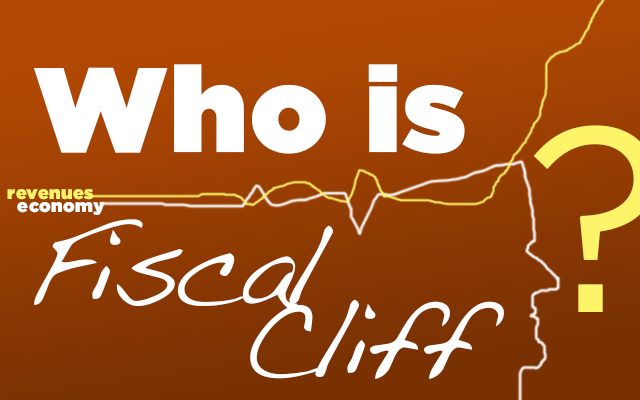
Who is “Fiscal Cliff”?

whois-fiscal_cliff

“Fiscal cliff” is a manner of speaking, not a fact of life. The trickle down economic theory holds that higher taxes automatically lead to economic downturn. We know, however, that economic history does not bear this out. We also know that severe cuts to public spending and social services limit the power of the Main Street purse, both consumers and employers. That most certainly does constrain economic activity.

The phrase “fiscal cliff”, derived from the metaphor “to go over the fiscal cliff”—itself derived from a visual analogy to an imaginary line graph tracking government budget calculations year on year and the impact some presume they will have on GDP—has been so often repeated during the last two months that it now seems to be a proper noun, i.e. Fiscal Cliff, either a person with an oddly descriptive name or an established institutional promontory permanently occupying the outer edge of our dysfunctional budget-making process.

To be honest about the whole thing, there is no fiscal cliff. That said… something like one might some day show up on some of those line graphs members of Congress are so fond of having their staff produce. You can see what one looks like if you make a line graph, for instance, of what happened to government revenues upon passage of the 2001 Bush tax cuts, which eliminated $2 trillion in taxpayer-sourced investment capital in one shot.

That particular sudden decline in government revenues was severe enough to be graphically rendered as a “fiscal cliff”, but the Bush administration’s well documented determination to increase spending by record amounts even as revenues declined meant the collapse of capital in the private sector came not suddenly, but seven years later—in the summer and fall of 2008, after the laborious inflation and deflation of a bubble economy based on home lending practices rife with fiction.

Unlike the destabilization of climate patterns across the world—which is already ongoing, has been evident for decades, and is now visible in extreme weather events during every month of every year, on every continent—the Fiscal Cliff proper has not yet become reality. It is, in fact, little more than a presumed set of economic trend-lines, projected out beyond our current experience, based on theory. Part of the logic is rooted in supply-side theories that have been proven wrong over and over again, but another part of the fiscal cliff talk is about Keynesian economics, which have been proven helpful at times of economic gloom.

It is not exactly true to say the so-called “fiscal cliff” is a fiction, but it is closer to true than to take the “fiscal cliff” for a foregone conclusion.

There are too many economic and political eventualities to consider, including the fact that the predicted collapse depends in part on the United States no longer being able to “borrow” by selling bonds—and that particular version of budgetary Armageddon looks ever more improbable, since the governments of world-leading economies across Europe are currently nowhere near as stable as the United States, and China is experiencing a slowdown in its record rates of growth.

For most of us to get a grip on the meaning of the “fiscal cliff”, it will be necessary to reframe the “cliff”, the steep and immediate decline, not as “fiscal” per se, but linked to GDP—our gross domestic product. There is the “haircut” theory, or in this case a “crew-cut” theory, that holds that as economic output declines, suddenly, so will our fiscal health, because there will be a vicious feedback loop, where cuts to government spending, coupled with tax increases, drain the private sector of capital, and reduced spending means a reduced tax base, and so declining revenues.

The doomsday scenario says that vicious cycle will be impossible to break, because increased government spending will not be an option, and further tax cuts will be unaffordable. This scenario, many believe, is not credible, because just as there is an upper threshold above which volumes of free cash cannot simply be invented out of thin air, there should also be a lower threshold below which the total wealth of the world’s leading economy cannot venture.

As of December 2, 2012, we can say the following:

  • if at current rates of economic expansion,
  • and the ongoing slowdown in home lending and property values,
  • in connection with major new reductions in spending on government services,
  • tax cuts for middle class families and working families,
  • along with the payroll tax cut, are not renewed, then…
  • there will be a depletion of immediate spending capital in the consumer economy.

It is not true, however, that expanding the upper-income tax rate from 35% to 39% on those making more than $250,000 per year, and only on that income that exceeds $250,000 per year, will drain the private sector of investment capital. The government will return that revenue to the private sector through spending, and wealthy investors will continue to invest, in order to expand that 61% they get to keep by as wide a margin as possible.

Billionaire investor Warren Buffet—an advocate of having his own taxes increased in order to make our budget situation more rational and shore up our economy over the long term—has warned that continuing to drain resources from government is a dangerous gamble that puts taxpayers, communities and ultimately the Main Street economy at risk. “People love to gamble,” he told NPR on Nov. 28, 2012… “people travel thousands of miles to do unintelligent things. It’s a very human characteristic, but it can be very expensive.”

The question we need to ask, before we can really get to the business of solving the fiscal cliff debate is: why do we need pundits, politicians and the press to talk up the “fiscal cliff” crisis to the point where they seem to believe it is an actual mountain outcropping in the landscape of Appalachia, or perhaps in the Rockies or the Sierra Nevada? Why do we chatter, without enough knowledge, until it seems the Fiscal Cliff is a real place that will be there no matter what we do.

The first answer is that the pundits, the politicians and the press do this to absolve themselves of the responsibility of coming up with a way to avoid it. It is real; it is solid; it is made of prehistoric rock formations, and we cannot ignore it. Therefore, to be “realistic” is to simply accept it as a fact of life, and not labor to understand a mountain as if it were just a passing fog. It is comforting, on some level, to believe it is not in our hands.

The second answer is that the pundits, the politicians and the press honestly believe we cannot understand the arithmetic, the economics or the policy complications, and so they need to give us a mascot—Fiscal Cliff—that we can hold onto for a sense of comfort and maybe for guidance, when we are feeling lonely in the night of absent-minded policy-making and non-citizen-focused government. We celebrate this mascot as we do any idol, for its own sake, and for the role it plays in giving us a sense of clarity.

The third answer is that the pundits, the politicians and the press are doing their best to make sense of a complicated problem, that has arisen over several decades of irresponsible policy-making, and we are responsible for taking interest in the policy complications inherent in budgeting wisely and avoiding the fiscal-economic vicious feedback loop that may or may not feel like free-fall, should it come.

The fourth answer is that the term is a red herring—a distraction that takes our attention off the problem at hand. In that case, we have to ask ourselves what we are being distracted from: cynical government? corrupt policy-making? irresponsible hatred of government? a cunning round of strategy among the partisans? some sort of piracy? the best efforts of some not very competent lawmakers? too much money given away to those who don’t need it and so will do nothing constructive with it? our own blindness?

Here’s a couple of ideas I think might help us to see what we are not seeing:

  • Let’s consider that the Fiscal Cliff is a result of persistent unwillingness to adequately fund the services we need, to be the kind of country we believe we should be. 
  • Let’s consider arithmetic: if you don’t provide the funding, the funding will not be there; and, if the funding is not there, the services will decline in quality or disappear altogether.
  • To oppose any and all forms of revenue for government is to be an opponent of quality American government.
  • In a people’s democracy, to be an opponent of quality American government is to be an opponent of the People.
  • A harmonious relationship between the public and private sectors has always been the cornerstone of American prosperity and middle class quality of life.
  • A harmonious relationship between the public and private sectors will help to resolve the budget shortfall crisis.

St. Augustine wrote that he was ashamed to have taken advantage of his parents and his teachers in so selfish a way as to disregard the value of their instruction, while later making use of it. For Augustine, the fact that ingratitude occurred before his later awareness of it—committing the infraction before being aware of what was wrong—was not an excuse; ignorance was, to his view, somehow, always willful, and ingratitude was an irrational and corrosive, self-centered advantage-taking.

Faced with the fiscal cliff conundrum—how do we fund something we are not sure we want to pay for?—we must first be honest about what is at stake. The government of the United States is the manifestation of the people’s revolution against tyranny. If we fund, and maintain, a high-quality public sector, in service of the expansion of the liberty of individuals, families and communities, and the building of an ever broader middle class, then we are doing the work we imagine we are doing; if we fail to fund and maintain such a government, then we betray ourselves, and sin against our own future.

Maybe Fiscal Cliff is our alter ego—that failed citizen who pretends to love democracy, but refuses to be a constructive contributor to its upkeep. Our citizenship, our participation, our demand for a real solution, is the solution.

No more posts.