On the Inestimable Value of Citizenship

There are speech acts that negate their own validity. For example, the defense or promotion of violence in service of the sacred, or the notion that to oppose marginalization and stereotyping, specific groups need to be treated as inherently and universally hostile to one’s aims, no negotiations allowed. To be a citizen is about choice and responsibility, but it is never a valid choice—or an expression of any genuine personal freedom—to refuse it.

To refuse citizenship is a self-negating performative speech act, intended in every case to serve as a kind of comment on the state of affairs—”that’s not for me”, “my interests lie elsewhere”, “they’re all corrupt”, “I would replace the whole system”, etc., or, sometimes unwittingly (subconsciously, as a way of sloughing off the burden of responsibility): “I want those in power to have free rein”. To refuse citizenship is an act of cruel self-sabotage the bad effects of which seep out into the rest of society and undermine the health and wellbeing of the whole citizenry.

Continue Reading

Stop the Violence Now

After the dignity and inspiration of the Arab Spring, what we are now witnessing in the United States has been an inspiration to millions of people who long to have a voice in their society. Yet some city governments are ordering the use of paramilitary assault tactics against unarmed civilians engaged in constitutionally protected peaceful assembly and free expression. In Oakland, we have now seen two displays of overwhelming, deliberate, combat-style police actions against unarmed civilians exercising their basic rights.

Video has emerged clearly confirming eyewitness reports that Oakland police fired directly into crowds of unarmed demonstrators with tear gas and flash-bang grenades. Scott Olsen, now famous the world over, was shot in the face when police fired “non-lethal” rubber bullets directly at protesters’ heads, at close range.  Video shows a combination flash-bang/teargas grenade being fired directly into the middle of a crowd of people attempting to tend to him as he lay bleeding on the ground.

Continue Reading

What is the Meaning of This?

The Occupy Wall Street movement—now being called “the American Autumn”, after the Arab Spring, or the September 17th movement, after the day it got started in lower Manhattan—is now completing four weeks on the scene. Yet we can still be astounded to hear so many incredulous “experts” unable to understand how a grassroots movement, infused with the zeitgeist of very problematic times, is working toward anything constructive. What is the meaning of this? Why don’t they have a ready-to-go list of demands? What are they asking us to think?

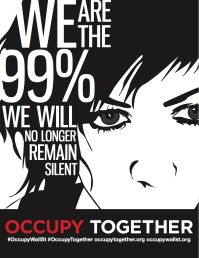
It’s actually very simple. It’s self-evident, but if you’re at a loss, you can also go to Zuccotti Park, or to any of the Occupy Together protest sites, and just talk to people, and what did not seem evident will rapidly become so. The meaning of the Occupy Wall Street movement that is spreading across the United States like wildfire is: democracy. The unifying sentiment, which is actively put into practice every day at Occupy encampments, is that citizens have a right to participate. They are building a participatory process to restore the principle of informed citizen participation to our political system and our economy.

Continue Reading

Bad Tax Policy Has Tragic Consequences

For the last three decades, we have heard that transferring wealth to the top of the income pyramid—to what used to be called “the supply side” of the macroeconomic equation, and is now referred to by the supply-side party, collectively, as “the job creators”—would make everybody else more affluent. We have been told that the natural result of pushing wealth in the direction of the wealthy would be massive hiring, and the “trickle down” effect, as wealth from the top eventually flows to everyone else.

The result has been a steady decline of the American middle class. Median household wealth, when excluding the wealthiest 1%, has declined. The income gap between CEOs and the average worker at their own firms has now leapt from a ratio of about 24:1, in the 1960s to well over 200:1 today. The entrepreneurial class—or rather, those best positioned to motivate major investment in entrepreneurial activity—were given huge amounts of money, and so saw less urgency in investing it.

Continue Reading

9/11 Should be a Day of National Reflection & Reaffirmation

The four coordinated hijackings, resulting in three deliberate attacks and one downed passenger jet, took 2,977 innocent lives and sowed fear and dismay across the world. They were acts of unconscionable evil intended to not only harm innocents and terrify the wider population, but to destabilize American democracy itself, and derail a people’s journey through history, possibly to erode its most virtuous contributions.

It was a clear, sunny morning and the first plane crashing into the North Tower of the World Trade Center had sparked a sustained global news flash, bringing hundreds of millions of eyes to the television footage. There was confusion and disbelief, and just as it was becoming clear there must have been a devastating loss of life, a massive fireball engulfed the top half of the South Tower, clearly signaling a deliberate terrorist attack was underway.

Continue Reading

The Mystery of the Progressive Open Market

Why is a struggling open market so hard to turn around? The answer is really quite simple: A centrally planned, totalitarian economy is easy to predetermine; in fact, that’s the point. An open market for the trade of goods and services cannot be predetermined, because its governing dynamics depend entirely on the manner in which goods and services are traded, at what volume and by whom, and direct command-and-control is likely an obstacle, not a source of efficiency.

Open markets, in their most virtuous state, foster the optimal distribution of resources, goods and services, and produce generalized value for all involved. It is at this point, where the middle class is the focus, and where it expands by inviting (and making possible) more membership from the less affluent segments of the socio-economic web, that open markets are democratizing in their effects. Intervention, then, needs to be subtle, and favor democratic outcomes, so less central control.

Continue Reading

Big Ideas to Solve the Debt Crisis & Restore the Middle Class

The debt crisis is attributable to “structural” causes, meaning the way the nation’s financing is structured over the next several decades, but also to political and economic causes, meaning both the way we make policy and the way we live and experience the marketplace for trade, credit and consumer purchases. So, we need to implement policies that make serious, sustainable corrections on all three fronts.

Stabilizing debt financing requires the least expensive cost of borrowing possible, i.e. a AAA credit rating and the reputation for 100% likelihood of on-time repayment. It is unhelpful and counterproductive to indicate that the US might not meet 100% of its obligations on time 100% of the time. The long-term solution has to be oriented toward making social services solvent, and reducing the costs of debt repayment.

Continue Reading

The Republican Candidates Debate in Iowa – A Full Report

Most of the Republican candidates for their party’s presidential nomination debated last night in Iowa, two days ahead of the crucial Ames Straw Poll, thought to be a leading indicator of which candidates are credible and which are less likely to win in January. Rick Perry, who has not yet announced his candidacy, was not in attendance, and Fred Karger—who met all the criteria for attendance—was not allowed to participate, some say because he is openly gay.

The questions were direct, tough and probing. Challenged on her claim that she could turn the US economy around in just three months, Michelle Bachmann fielded the first of many tough questions. She backtracked somewhat, claiming that she could not fix the economy in three months, but that she could enact policies that could eventually have a positive impact. She then trailed off into a “one term president” rant against Obama, which opened her to the critique that her policy plans lack substance.

Continue Reading

Toward a Creative Prosperity Agenda

creative prosperity is sustainable prosperity

To build a future of vibrant open democracy and robust and sustainable economic prosperity, it is necessary to privilege creative activities and constructive solutions to the challenges we face. Addressing major challenges in constructive, innovative ways, is the single most significant driver, historically, of sustained economic booms. In short, we need to move deliberately and swiftly toward a creative prosperity agenda.

The first consideration, then, is to examine how the creative prosperity agenda would differ from what we are doing now. At present, we are wrestling with the complex fabric of consequence related to long-running economic distortions, most of which we have not yet corrected. Healthcare reform and financial regulatory reform were comprehensive in scope, but moderate in impact, cautious and rooted in the prevailing model; energy reform needs to move forward rapidly and do more to prioritize innovation.

Continue Reading

What’s Wrong with the Stock Market?

What’s wrong with the stock market, particularly the New York Stock Exchange and the Dow Jones Industrial Average? The most significant problem facing the stock market is really a confluence of two problems: 1) we have too little middle class wealth, and so too little consumer demand, and 2) we face an urgent need to accelerate the transition to a new economy, but we are focused on trying to revive an old economy.

On Thursday, August 4, the Dow Jones Industrial Average dropped almost 513 points, losing 4.3% of its total value, the worst one-day decline since December 2008, and an effective reversal of 8 months’ worth of gains. It happened two days after the United States avoided a default by raising the debt ceiling and cutting government spending by about $250 billion per year over the next 10 years.

Continue Reading

No more posts.