A Call for Global Citizenship

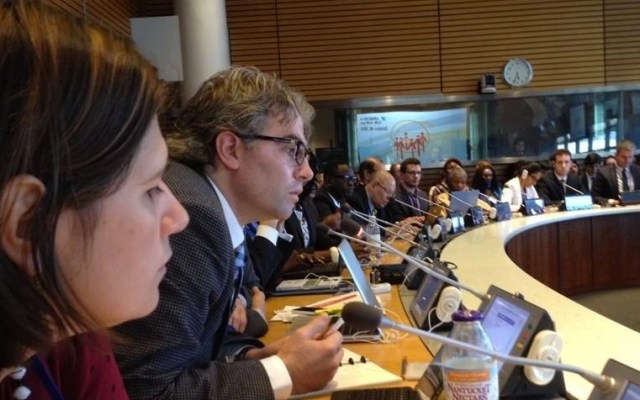
Report from the World Bank / IMF Civil Society Forum

In the years I have been attending and contributing to the World Bank / IMF Civil Society Policy Forum, I have witnessed a distinct and ongoing evolution. Multilateral institutions like the World Bank and IMF, which are funded by and directed by governments, and which do business with governments, have direct impacts on elements of society that are not in the room when decisions are made. So civil society organizations have an important role to play in highlighting and reducing major risk areas, and in shaping policies that lead to better outcomes.

Continue Reading

Gratitude for Your Citizenship

It is Thanksgiving Day, and I think a lot of us are having the experience of people perking up to what is of real value and giving thanks for people in their lives, even where there have been differences and frictions in the past. In a democratic society, with real freedom of expression, assembly and political engagement, we should all be thankful to anyone who speaks up. Even where we disagree with what is said, we are enriched and empowered by their exercising those basic freedoms.

Continue Reading

JFK: Voice of Collective (Non-partisan) Aspiration

Nov. 22, 1963. Three shots. Historical shock. The near destabilization of the American system. A hurried reordering of executive leadership and governing priorities. Every question asked, and unanswered. Importantly. Exactly fifty years ago today, Pres. John Fitzgerald Kennedy, Jr., was shot and killed, in Dallas, Texas. Though official filings cite Lee Harvey Oswald as the lone assassin, no judicial process has ever found him guilty. Instead, we have the controversial and selective report from the Warren Commission, and the shooting remains a more or less unsolved mystery.

Ultimately, what matters most is what we learn and what we put into effect.

Continue Reading

The Gettysburg Address

150 years ago today, President Abraham Lincoln delivered his most famous speech, at the consecration of a memorial to the Union soldiers who died at Gettysburg. The text is transcribed here, to remember the spirit and the legacy of that day.

Four score and seven years ago our fathers brought forth on this continent, a new nation, conceived in Liberty, and dedicated to the proposition that all men are created equal.

Now we are engaged in a great civil war, testing whether that nation, or any nation so conceived and so dedicated, can long endure. We are met on a great battle-field of that war. We have come to dedicate a portion of that field, as a final resting place for those who here gave their lives that that nation might live. It is altogether fitting and proper that we should do this.

But, in a larger sense, we can not dedicate — we can not consecrate — we can not hallow — this ground. The brave men, living and dead, who struggled here, have consecrated it, far above our poor power to add or detract. The world will little note, nor long remember what we say here, but it can never forget what they did here. It is for us the living, rather, to be dedicated here to the unfinished work which they who fought here have thus far so nobly advanced. It is rather for us to be here dedicated to the great task remaining before us — that from these honored dead we take increased devotion to that cause for which they gave the last full measure of devotion — that we here highly resolve that these dead shall not have died in vain — that this nation, under God, shall have a new birth of freedom — and that government of the people, by the people, for the people, shall not perish from the earth.

Abraham Lincoln
November 19, 1863

Here’s an Idea

Let democracy be democracy.

President Barack Obama was conciliatory with the “responsible Republicans” who found a way to make a deal with Democrats and pass the continuing budget resolution that last night ended the government shutdown and raised the national sovereign debt ceiling. But he was hard on the radicals who not only took the people’s government and national political process hostage, demanding ransom for reopening the government, but who also voted last night to push the nation into default.

A fair-minded independent can sympathize. No president should have to face the threat that a radical minority in Congress will set figurative fire to the edifice of democratic government, unless they can extract the concessions they seek. We sometimes have presidents from the Republican Party, sometimes from the Democratic Party; each of them is the president who leads the government that works for all of us, for all citizens.

Continue Reading

It is Unfathomable that the Congress Not Act Today

Today, October 16, is the last day the United States Congress has to raise the so-called debt ceiling. International financial institutions, both public-sector and for-profit, have warned that failure to raise the debt ceiling would result in a credit downgrade for the most influential “borrower” in the world. Virtually every economy on Earth is tied to US Treasury bonds; failure to meet any debt obligation can have significant destabilizing impact on the global economy.

So far, radicals in the US Congress have held to two very dangerous misimpressions: 1) that whatever they cause to happen, they can undo by making a deal; 2) that there is really nothing to worry about, in terms of widespread economic impact from shutting down the US government or provoking a sovereign debt default. Let’s look at those myths, for a minute:

Continue Reading

Fourth of July: Egypt at a Crossroads

On January 25, 2011, the people of Egypt began a nonviolent uprising against 3-decade dictator Hosni Mubarak. On February 11, 2011, Egypt became the second nation of the Middle East / North Africa (MENA) region, after Tunisia, to oust a long-standing dictator in this way. Mubarak’s forces killed near 1,000 civilians, but never succeeded in slowing the growth of the nationwide movement.

Continue Reading

Erdogan Declares Unilateral Authority over Speech, Threatens Violence

The Turkish prime minister, Recep Tayyip Erdogan, has issued what the Guardian newspaper calls a “chilling warning”: he says “these protests will be over in 24 hours”. After calling nonviolent protesters “destroyers” and “enemies”, Erdogan declared “this episode is over”. He now has effectively declared his absolute, unilateral authority to accept or reject any and all attempts at democratic speech.

Observers across democratic nations allied with Turkey have expressed dismay and alarm at the unnecessarily counterproductive, violent and authoritarian reaction to what began as a sit-in protesting the destruction of a public park for commercial development. The extreme nature of Erdogan’s reaction has raised questions about whether his government somehow has existential ties to the commercial development plan.

Continue Reading

Why Taksim Square Matters

The mass protest movement that has flooded through Turkish society, over the last few weeks, is of great importance to the future of international politics, not least because President Erdogan’s reaction has been so ham-fisted and unacceptable. As the head of government of a NATO allied nation with a constitutional mandate for secular government, Erdogan, leader of a religious party, has always had to walk a fine line; the protest movement has shown how superficial some of his moderate language may have been.

With what is considered to be genuine popularity, Erdogan has accumulated what many believe is an unhealthy amount of power, and he has allegedly been impatient with dissent of all kinds. What Taksim Square represents for Turkey, however, is the first true modern movement in defense of stakeholders’ rights. And that, many believe, is the 21st-century liberation struggle which even the most advanced democracies will have to confront: freedom of speech is one thing, freedom of the press another, both necessary for any genuine democracy to exist, but without a real, and influential voice, for stakeholders, any process of decision-making must be described as less than entirely democratic.

Continue Reading

8 Steps to Fuel Free Sustainable Democracy

We can build a 100% fuel free full-spectrum sustainable democracy.

With 8 conceptually simple, and practically far-reaching framework upgrades, we can accelerate the pace of change and motivate a paradigm shift in the way we address climate destabilization, without any command-and-control or dubious financial wizardry:

  1. Full-spectrum sustainable communities (FSSC)
  2. Calculation of climate debt amassed to date
  3. Focus on speeding over the horizon tech to market
  4. Smart grid
  5. Solar highway infrastructure
  6. Maximum flexibility in clean fuel choice
  7. Grassroots-capacitative Fuel Free Media Network
  8. Citizen leadership on federal policy-making

Continue Reading

No more posts.