GOOD-based Economics: How to Build the Middle Class

Our political system is not, strictly, a macroeconomic guidance machine; political leaders have a lot of responsibilities that take day-to-day precedence over direct macroeconomic maneuvering. Stewardship of our civic infrastructure can provide direct benefits to citizens, communities, and enterprise, and so our analysis of how well our policy choices work to motivate real macroeconomic health and improvement needs to consider those other values.

We all know, from one perspective or another, how ideological preferences influence what one analyst or another might refer to as “just the numbers”; this is one of the main reasons there is such heated disagreement about whose policy preferences do better at creating value for households, communities, and enterprise. By adding to our value considerations a G.O.O.D. economic analysis, we can better see the generative capacity of a given policy priority, economic trend, or technical innovation.

Continue Reading

Common Sense Demands Collaboration

The word politics comes from polis, the Greek word for city, or state. Politics is the art of living amongst people. It is, at the root, and in practice, a project of collaborative problem-solving. In its broadest sense, it is a way to describe our process of learning how to talk about value with those around us; it is the study of what happens when people make choices, relying on free will and individual expression. Cynics, with either too much or too little immediate access to power, often argue there can be no real freedom and little cause for faith in humanity. That has never been the case. We constantly exercise our power of observation, our judgment, and our freedom to choose; this is how we relate to every person we know. In this sense, politics is what Jacques Derrida referred to as peri-philías: an examination of the nature of friendship. We form affinities, friendships, families, communities, alliances; we apply our vision, our judgment, our imaginations, and our best use of shared language, to hold the world together. It is to our benefit that choices lead to consequence, so we can choose better, improve outcomes, redress our failings. The question is: Do we build on each other’s strengths?

Continue Reading

Citizens Engage World Governments in Lima

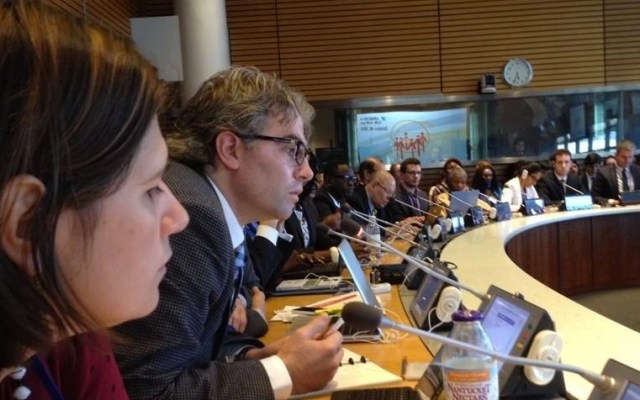
The 20th Conference of the Parties, held in Lima last month, produced a consensus agreement among 195 governments, which provides the draft structure for “an agreed outcome with legal force” to be finalized in Paris, in December 2015. During the Lima Conference, governments engaged each other, non-governmental organizations engaged the process, and through Citizens’ Climate Lobby and the Pathway to Paris project, I had the privilege of helping to bring the voices of citizens from around the world directly into the process.

Continue Reading

Climate Security Threat Matrix Must Be Priority

The climate system is a complex of thermodynamic energy transfers, moving between the Earth’s atmosphere and oceans. Our local experience of weather—hot summers, breezy autumns, monsoon rains, tropical cyclones, droughts, floods, blizzards and mudslides—is an expression of the way climatic forces play out over time.

As more thermodynamic energy gets trapped in the Earth’s atmosphere and oceans, the excess destabilizes patterns of energy transfer that sustain vital ecosystems. Those ecosystems sustain life as we know it. When the global climate system’s dominant patterns are destabilized, vast and complex new security risks emerge.

Continue Reading

Respect is a Catalyst for Success

Politics is hard. Making policy that appeals to a wide range of political actors, stakeholders, and related interests, is by some people’s estimation functionally impossible. But at the heart of every legitimate political endeavor, there is the core insight that in its most expansive sense, what is of real interest to humanity anywhere is of real interest to humanity everywhere. We are connected by certain shared truths. We require certain sustenance to facilitate our survival, and we are all vulnerable to the forces of nature and of human violence. We have a transcendent, reciprocal interest in humane policy processes that protect life-giving systems. Working with people of all views and from around the world, on something as complex as climate, I have witnessed firsthand to what degree respect is the most effective strategy for building up the possibility of effective outcomes.

Continue Reading

Overcoming the Dissociation Crisis

A report on the Global Online Policy Forum: Solutions from Crisis, from the Pathway to Paris project…

Systems thinking views systems as already containing the expression of their own virtues and their own failings. A system cannot fail, unless the failure is made possible by some component of the system. In our use of energy, in contact with the Earth’s climate system, there is a flaw: our system is not designed to maintain a reliable climate-energy balance. So, we are pushing past the limits of the system, and motivating/encountering disruption. If we understand this, we can better see our limits, understand our strengths, and leverage the virtues of the system to achieve an outcome conducive to human thriving.

Continue Reading

When Citizens are Involved, Lawmakers Respond

The people have a right to co-create policy with our representatives.

Political analysts around the world have been noting the extreme negative tone of the 2014 midterm election campaign in the U.S. Outside groups that are spending hundreds of millions of dollars on smears and innuendo are degrading the political debate. The ugliness of the campaign has exacerbated the bitterness many Americans feel toward the political process itself.

That bitterness tends to be connected to a feeling of detachment or of access denied. People believe they do not have access to their elected officials and that the parties do not respond to their day-to-day needs. This detachment is driven partly by the apparent inability of leading national political figures to work together, which leaves a great deal of important work unfinished.

Continue Reading

A Call for Global Citizenship

Report from the World Bank / IMF Civil Society Forum

In the years I have been attending and contributing to the World Bank / IMF Civil Society Policy Forum, I have witnessed a distinct and ongoing evolution. Multilateral institutions like the World Bank and IMF, which are funded by and directed by governments, and which do business with governments, have direct impacts on elements of society that are not in the room when decisions are made. So civil society organizations have an important role to play in highlighting and reducing major risk areas, and in shaping policies that lead to better outcomes.

Continue Reading

Climate Change is a Threat Multiplier

Climate Security Roundtable at American Legion discusses nexus between energy, water, food & national security

Citing the 2010 Quadrennial Defense Review, Brigadier General Gerald Galloway (ret.), on Friday June 27, told representatives of the American Legion, the Veterans of Foreign Wars, the Earth Policy Institute and Citizens’ Climate Lobby, that “climate change is a threat multiplier” and will shape the future operating environment. As water and food become more scarce and life-supporting ecosystems are degraded, as the costs of coping with disasters rise, the opportunities for chaos and instability to take root also increase.

Continue Reading

Putin Squanders Olympic Glow to Seize Crimea

Russian President Vladimir Putin has thrown away the halo of global good feeling that might have come with the success of the Sochi Olympic Games. Russia’s hosting of the Games was marred when armed paramilitary extremists linked to Putin publicly whipped members of the punk rock protest band Pussy Riot, but Putin’s government handled that situation by scolding the responsible Cossacks and denouncing such abuse of citizens.

Continue Reading

No more posts.