Beyond the Perverse Politics of Partisan Sabotage

A desperate situation has overtaken the national organizing structure of the Republican Party: the party’s primary electorate is heavily skewed by radical anti-government fringe politics, while the national culture has shifted—demographically and ideologically—away from right-wing jingoism and militancy. The party’s leadership no longer has adequate friendly political affiliation throughout the base and the rank-and-file.

Consequently, some observers now believe the party has been rendered functionally irrelevant. It talks of austerity, fiscal responsibility, small government and tax cuts, but its actions show a pathological disregard for the actual wellbeing of the American people and the security of the national economy. It may be possible to show that the tug-of-war between a pseudo-populist fringe base and top-level billionaire funding interests is doing this to the party.

The perverse politics that requires the party to adopt a hapless “burn-it-down” attitude toward nearly every issue of major structural relevance to the future of our economy—healthcare reform, tax policy, immigration, assault weapons, the debt ceiling, the funding of earned entitlements and the fiscal cliff negotiations—may seem irrevocable. But there are some easy things Republican leaders can do to pull their party back from the brink.

First of all, it became clear to most astute observers that despite the wild inspirational quality of the 2008 election environment, both Pres. Obama’s governing style and the mood of the country, confronted with such pervasive and long-running economic and security perils, were nudging the political apparatus of the country toward a focus on pragmatic problem solving. In 2010, the Republican Party misunderstood that mood change, instead retrenching into a deep ideological groove, and in 2012, the election clearly showed support for Pres. Obama as the leader in this pragmatic problem-solving mission.

So, to abandon ideology and adopt an approach to principle pragmatic problem-solving, committing to work with anyone willing to do the hard work of governing and serving, is a necessary first step toward regaining relevance and taking part in important national achievements. The president has consistently made the case that he is doing this, and the public has supported him in that effort. The top-level Republican leadership needs to steer its next-level legislative leadership into this mode, to help organize a party-wide transformation that will allow for more reasoned, more rational negotiating on issues like the negotiations about the Bush tax cut expiration and budget sequestration—the twin perils that have become known as “the fiscal cliff”.

Here’s how that can happen:

  • Walk away from lame duck Grover Norquist, whose zero taxes ever pledge is now seen by most Americans as a direct threat to the nation;
  • Reimagine the meaning of the word “entitlement”—to most Americans, and as a matter of law, entitlements are “earned benefits”;
  • Commit to acting with profound respect toward those earned benefits and basic services (like quality education) that no citizen is willing to give up;
  • Walk the walk on Constitutional liberties and immigration: small government and family values are incompatible with an effort to round up 15 million people, throw them in camps, then send them out of the country;
  • Get with the Dreamers: people view the DREAM Act concept as integral to the American Dream and conducive to a more prosperous and democratic future;
  • Be rational about Defense: from 2001 to 2012, the Pentagon budget expanded nearly four-fold, due to two ongoing wars, which are now ending;
  • Make a deal with Obama that shows genuine willingness to compromise: that means give without crippling the nation;

Most Americans believe Pres. Obama has consistently shown willingness to bend, to find the compromise necessary to serve the interests of the American people. Polls show most Americans will blame Congressional Republicans if a deal is not reached. Pres. Obama has rightly said the nation “cannot afford a politically self-inflicted wound” to the economy.

The Fiscal Cliff negotiations are an incomparable opportunity for the Republican leadership to eschew the logic of partisan sabotage as an organizing principle, and act in service of the American people.

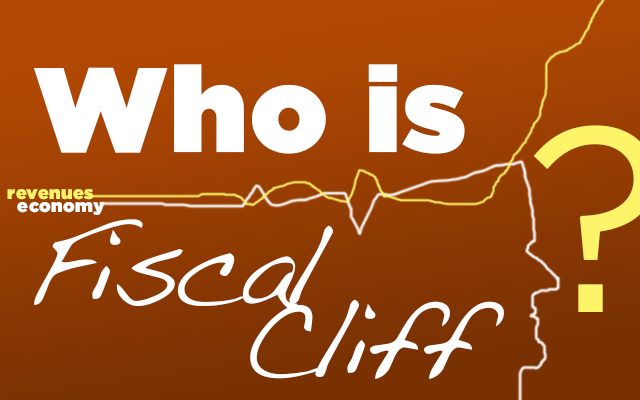
Who is “Fiscal Cliff”?

whois-fiscal_cliff

“Fiscal cliff” is a manner of speaking, not a fact of life. The trickle down economic theory holds that higher taxes automatically lead to economic downturn. We know, however, that economic history does not bear this out. We also know that severe cuts to public spending and social services limit the power of the Main Street purse, both consumers and employers. That most certainly does constrain economic activity.

The phrase “fiscal cliff”, derived from the metaphor “to go over the fiscal cliff”—itself derived from a visual analogy to an imaginary line graph tracking government budget calculations year on year and the impact some presume they will have on GDP—has been so often repeated during the last two months that it now seems to be a proper noun, i.e. Fiscal Cliff, either a person with an oddly descriptive name or an established institutional promontory permanently occupying the outer edge of our dysfunctional budget-making process.

To be honest about the whole thing, there is no fiscal cliff. That said… something like one might some day show up on some of those line graphs members of Congress are so fond of having their staff produce. You can see what one looks like if you make a line graph, for instance, of what happened to government revenues upon passage of the 2001 Bush tax cuts, which eliminated $2 trillion in taxpayer-sourced investment capital in one shot.

That particular sudden decline in government revenues was severe enough to be graphically rendered as a “fiscal cliff”, but the Bush administration’s well documented determination to increase spending by record amounts even as revenues declined meant the collapse of capital in the private sector came not suddenly, but seven years later—in the summer and fall of 2008, after the laborious inflation and deflation of a bubble economy based on home lending practices rife with fiction.

Unlike the destabilization of climate patterns across the world—which is already ongoing, has been evident for decades, and is now visible in extreme weather events during every month of every year, on every continent—the Fiscal Cliff proper has not yet become reality. It is, in fact, little more than a presumed set of economic trend-lines, projected out beyond our current experience, based on theory. Part of the logic is rooted in supply-side theories that have been proven wrong over and over again, but another part of the fiscal cliff talk is about Keynesian economics, which have been proven helpful at times of economic gloom.

It is not exactly true to say the so-called “fiscal cliff” is a fiction, but it is closer to true than to take the “fiscal cliff” for a foregone conclusion.

There are too many economic and political eventualities to consider, including the fact that the predicted collapse depends in part on the United States no longer being able to “borrow” by selling bonds—and that particular version of budgetary Armageddon looks ever more improbable, since the governments of world-leading economies across Europe are currently nowhere near as stable as the United States, and China is experiencing a slowdown in its record rates of growth.

For most of us to get a grip on the meaning of the “fiscal cliff”, it will be necessary to reframe the “cliff”, the steep and immediate decline, not as “fiscal” per se, but linked to GDP—our gross domestic product. There is the “haircut” theory, or in this case a “crew-cut” theory, that holds that as economic output declines, suddenly, so will our fiscal health, because there will be a vicious feedback loop, where cuts to government spending, coupled with tax increases, drain the private sector of capital, and reduced spending means a reduced tax base, and so declining revenues.

The doomsday scenario says that vicious cycle will be impossible to break, because increased government spending will not be an option, and further tax cuts will be unaffordable. This scenario, many believe, is not credible, because just as there is an upper threshold above which volumes of free cash cannot simply be invented out of thin air, there should also be a lower threshold below which the total wealth of the world’s leading economy cannot venture.

As of December 2, 2012, we can say the following:

  • if at current rates of economic expansion,
  • and the ongoing slowdown in home lending and property values,
  • in connection with major new reductions in spending on government services,
  • tax cuts for middle class families and working families,
  • along with the payroll tax cut, are not renewed, then…
  • there will be a depletion of immediate spending capital in the consumer economy.

It is not true, however, that expanding the upper-income tax rate from 35% to 39% on those making more than $250,000 per year, and only on that income that exceeds $250,000 per year, will drain the private sector of investment capital. The government will return that revenue to the private sector through spending, and wealthy investors will continue to invest, in order to expand that 61% they get to keep by as wide a margin as possible.

Billionaire investor Warren Buffet—an advocate of having his own taxes increased in order to make our budget situation more rational and shore up our economy over the long term—has warned that continuing to drain resources from government is a dangerous gamble that puts taxpayers, communities and ultimately the Main Street economy at risk. “People love to gamble,” he told NPR on Nov. 28, 2012… “people travel thousands of miles to do unintelligent things. It’s a very human characteristic, but it can be very expensive.”

The question we need to ask, before we can really get to the business of solving the fiscal cliff debate is: why do we need pundits, politicians and the press to talk up the “fiscal cliff” crisis to the point where they seem to believe it is an actual mountain outcropping in the landscape of Appalachia, or perhaps in the Rockies or the Sierra Nevada? Why do we chatter, without enough knowledge, until it seems the Fiscal Cliff is a real place that will be there no matter what we do.

The first answer is that the pundits, the politicians and the press do this to absolve themselves of the responsibility of coming up with a way to avoid it. It is real; it is solid; it is made of prehistoric rock formations, and we cannot ignore it. Therefore, to be “realistic” is to simply accept it as a fact of life, and not labor to understand a mountain as if it were just a passing fog. It is comforting, on some level, to believe it is not in our hands.

The second answer is that the pundits, the politicians and the press honestly believe we cannot understand the arithmetic, the economics or the policy complications, and so they need to give us a mascot—Fiscal Cliff—that we can hold onto for a sense of comfort and maybe for guidance, when we are feeling lonely in the night of absent-minded policy-making and non-citizen-focused government. We celebrate this mascot as we do any idol, for its own sake, and for the role it plays in giving us a sense of clarity.

The third answer is that the pundits, the politicians and the press are doing their best to make sense of a complicated problem, that has arisen over several decades of irresponsible policy-making, and we are responsible for taking interest in the policy complications inherent in budgeting wisely and avoiding the fiscal-economic vicious feedback loop that may or may not feel like free-fall, should it come.

The fourth answer is that the term is a red herring—a distraction that takes our attention off the problem at hand. In that case, we have to ask ourselves what we are being distracted from: cynical government? corrupt policy-making? irresponsible hatred of government? a cunning round of strategy among the partisans? some sort of piracy? the best efforts of some not very competent lawmakers? too much money given away to those who don’t need it and so will do nothing constructive with it? our own blindness?

Here’s a couple of ideas I think might help us to see what we are not seeing:

  • Let’s consider that the Fiscal Cliff is a result of persistent unwillingness to adequately fund the services we need, to be the kind of country we believe we should be. 
  • Let’s consider arithmetic: if you don’t provide the funding, the funding will not be there; and, if the funding is not there, the services will decline in quality or disappear altogether.
  • To oppose any and all forms of revenue for government is to be an opponent of quality American government.
  • In a people’s democracy, to be an opponent of quality American government is to be an opponent of the People.
  • A harmonious relationship between the public and private sectors has always been the cornerstone of American prosperity and middle class quality of life.
  • A harmonious relationship between the public and private sectors will help to resolve the budget shortfall crisis.

St. Augustine wrote that he was ashamed to have taken advantage of his parents and his teachers in so selfish a way as to disregard the value of their instruction, while later making use of it. For Augustine, the fact that ingratitude occurred before his later awareness of it—committing the infraction before being aware of what was wrong—was not an excuse; ignorance was, to his view, somehow, always willful, and ingratitude was an irrational and corrosive, self-centered advantage-taking.

Faced with the fiscal cliff conundrum—how do we fund something we are not sure we want to pay for?—we must first be honest about what is at stake. The government of the United States is the manifestation of the people’s revolution against tyranny. If we fund, and maintain, a high-quality public sector, in service of the expansion of the liberty of individuals, families and communities, and the building of an ever broader middle class, then we are doing the work we imagine we are doing; if we fail to fund and maintain such a government, then we betray ourselves, and sin against our own future.

Maybe Fiscal Cliff is our alter ego—that failed citizen who pretends to love democracy, but refuses to be a constructive contributor to its upkeep. Our citizenship, our participation, our demand for a real solution, is the solution.

Education Must Be Leading Priority for Vibrant, Sustainable Future

National priority: world-leading education

The United States of America has been, since its birth 236 years ago, a world leader in promoting universal public education. It has also been a world leader in promoting universal access to higher education and to advanced degrees. That history has made the US a leader in technological innovation and advanced problem solving for two centuries. That legacy is under threat, and our list of national educational aims demands immediate attention.

In the current budgetary and economic climate, cuts to public education, the rolling back of teachers’ salary opportunities, job security and benefits, and the underfunding of financial aid for higher education, are threatening to stunt the quality of education available to millions of Americans. But education is the key to strong, resilient democracy and the only way to build a secure and prosperous future.

The National Strategic Narrative report, from two top Pentagon analysts working for then chairman of the Joint Chiefs of Staff, Adm. Mike Mullen, found that the United States must put top-quality education above all other priorities, privilege the virtues of sustainability in economic and security policy, and leverage mutually beneficial relationships with foreign powers, in order to build a truly vibrant and secure 21st-century democracy, with a global strategy adequate to the challenges we face.

The value of top quality education for the future of any society is almost incalculable: it affects the relative value of all other elements of the economy, and the efficacy of all areas of public policy, governance and democratic process, including security policy and conflict resolution. There is substantial evidence that lack of universalized top-quality education imposes major costs on entire societies.

Those added cost burdens, from economic and policy inefficiency, to counterproductive security actions, degraded infrastructure and sluggish entrepreneurial activity, can degrade the quality of life for most people in a society, degrade the quality of public discourse and public policy action, and undermine national security and economic prosperity, generally.

Lower quality educational resources build into a society patterns of unnecessary waste and degradation. Top quality educational resources build into a society the capacity for vibrant, rapid, innovative adaptation to changes in an evolving landscape. With the 21st century more likely to be defined by an evolving global political and economic landscape, nothing is of more paramount concern than the quality of education available to every last person living within a given geographical area.

Nothing will define a nation’s ability to compete in international markets more directly or comprehensively than the level of educational opportunity enjoyed by its people.

The age of complex informational problem-solving

We are entering an age that is no longer about building industrial capacity or penetrating beyond new frontiers in terms of geographical or spatial exploration. Technology is advanced enough that many new technologies can be mapped out intelligently long before they are within the realm of the practical.

We are entering an age in which the ability of an individual, a company, a region or a nation, to solve problems rapidly, efficiently and with little resulting negative feedback, will be the decisive factor in determining success or failure, prosperity or ruin. Borrowing problem-solving capacity from another society is not like borrowing industrial capacity; there is no way to export the cost while importing the benefit.

If the United States is to prosper in the 21st century as it did during the 20th, if it is to lead on the global stage in a credible way, it has to maintain its ability to be the most credible, open and constructive resource for problem-solving, and that means it must have the best quality human capital, the most talent, the most informed, creative and forward-thinking population.

Pres. Obama instituted one of his boldest and least well-known reforms in 2009, when he replaced the expensive, slow and bank-run system of student financial aid with a more direct system of loans from the government to students, with incentives for repayment, lower interest rates, better access to top-flight institutions, and long-term incentives to make use of one’s talents in ways that benefit the wider economy and the nation.

That student financial aid reform must be a building block, with new initiatives at the state and national levels both to foster not test-score improvements, but genuine improvements in educational quality, critical thinking, creative reasoning and intellectual skills that infuse the landscape of scientific and commercial innovation with real potential for designing and riding the wave of the new economy of this century.

We are falling behind, even in our policy aims

But we are not doing all that we should to promote top-quality, world-leading education. In too man ways, public officials are either looting education budgets to fund unaffordable tax giveaways or imposing counterproductive bureaucratic regimes designed to punish teachers and telegraph student training for test-taking, effectively gutting our educational system’s ability for providing the challenges, the resources and the personal commitment to excellence that we know produce the best outcomes.

As the New York Times reports, a new study from the Center for American Progress and the Center for the Next Generation—’The Competition that Really Matters‘—finds:

  • Half of U.S. children get no early childhood education, and we have no national strategy to increase enrollment.
  • More than a quarter of U.S. children have a chronic health condition, such as obesity or asthma, threatening their capacity to learn.
  • More than 22 percent of U.S. children lived in poverty in 2010, up from about 17 percent in 2007.
  • More than half of U.S. postsecondary students drop out without receiving a degree.

Meanwhile, China is investing heavily in education, planning to build the largest, most holy educated, most skilled workforce in world history. By 2020, China’s current policy trajectory aims to:

  • Enroll 40 million children in preschool, a 50 percent increase from today.
  • Provide 70 percent of children in China with three years of preschool.
  • Graduate 95 percent of Chinese youths through nine years of compulsory education (that’s 165 million students, more than the U.S. labor force).
  • Ensure that no child drops out of school for financial reasons.
  • More than double enrollment in higher education.

Taking it to the local, getting involved

The people of New York City have choices. We are at a moment of reckoning. We can choose to spend money to help transnational corporations pad their quarterly reports or we can choose to fund the world-leading infrastructure for education, innovation, citizenship, transport and public safety we all believe we deserve.

If you want to have a good idea of whether your kids’ school is focused on educating your children for global citizenship and intellectual mastery or simply training them as bureaucracy-reinforcing test-takers, find out how the administrators think about the city’s regime of high-stakes testing.

If your school’s administrators are obsessed with bumping test scores, or frame all discussion of student progress in terms of numbers and data, they are likely applying their own intellectual capacity to harnessing your kids’ intelligence for test-score improvement. These regimes carry with them a powerful psychological reorganization of reality, and whole school systems can find their better knowledge about educational excellence cast aside in favor of dangerous fictions and short-term thinking.

A certain kind of curriculum distortion tends to follow—specifically: the kind that downplays arts, cognitive complexity, advanced reasoning, precise language usage and creativity, focusing instead on how to solve the specific kind of math or reading-comprehension problems found on standardized tests.

If your school’s administrators talk a lot about math and science as skill areas for future growth, but emphasize active learning of art, music, precise language usage, cognitive complexity, advanced reasoning and even physical education, as vital for the healthy development of the individual mind, then they are likely focusing on producing the best outcome for your kids.

Here too, a certain kind of curriculum enhancement tends to follow—specifically: emphasizing students’ ability to experience a wide range of intellectual, physical and psycho-synthetic challenges, so their ability to synthesize the substance of their experience into one fabric of imaginative practical capacity (talent) is expanded and fortified for future application.

Recommendations

  1. Ask for more programs, with richer content, creative practice and physical experience, for your kids.
  2. Ask administrators to do what they are supposed to do—succeed by making themselves, and the regime of administrative labor, invisible. Their work should be so effective that everyone else is empowered, without even noticing the achievement, to do what they do and to excel.
  3. Talk to educators, parents, community leaders, and elected officials about what will actually work to achieve the ultimate goal of top-quality education: making students into fully intellectually self-reliant full-functioning citizens of a vibrant democracy.
  4. Make sure arbitrary qualifiers—like impersonal data, test-score tracking, budget itemization and administrative paperwork requirements—are not interfering with genuine instruction and learning.
  5. Look for opportunities to supplement your kids’ school-hours education, then to bring those kind of activities into the school building or school yard.
  6. In your community and across the local apparatus of policy-making, work to build interest in a full-spectrum empowerment paradigm: an education that builds intellectual, civic and professional value for the whole character and ability of each student.

– – –

The Sandy Chronicle: Our Humanity Matters

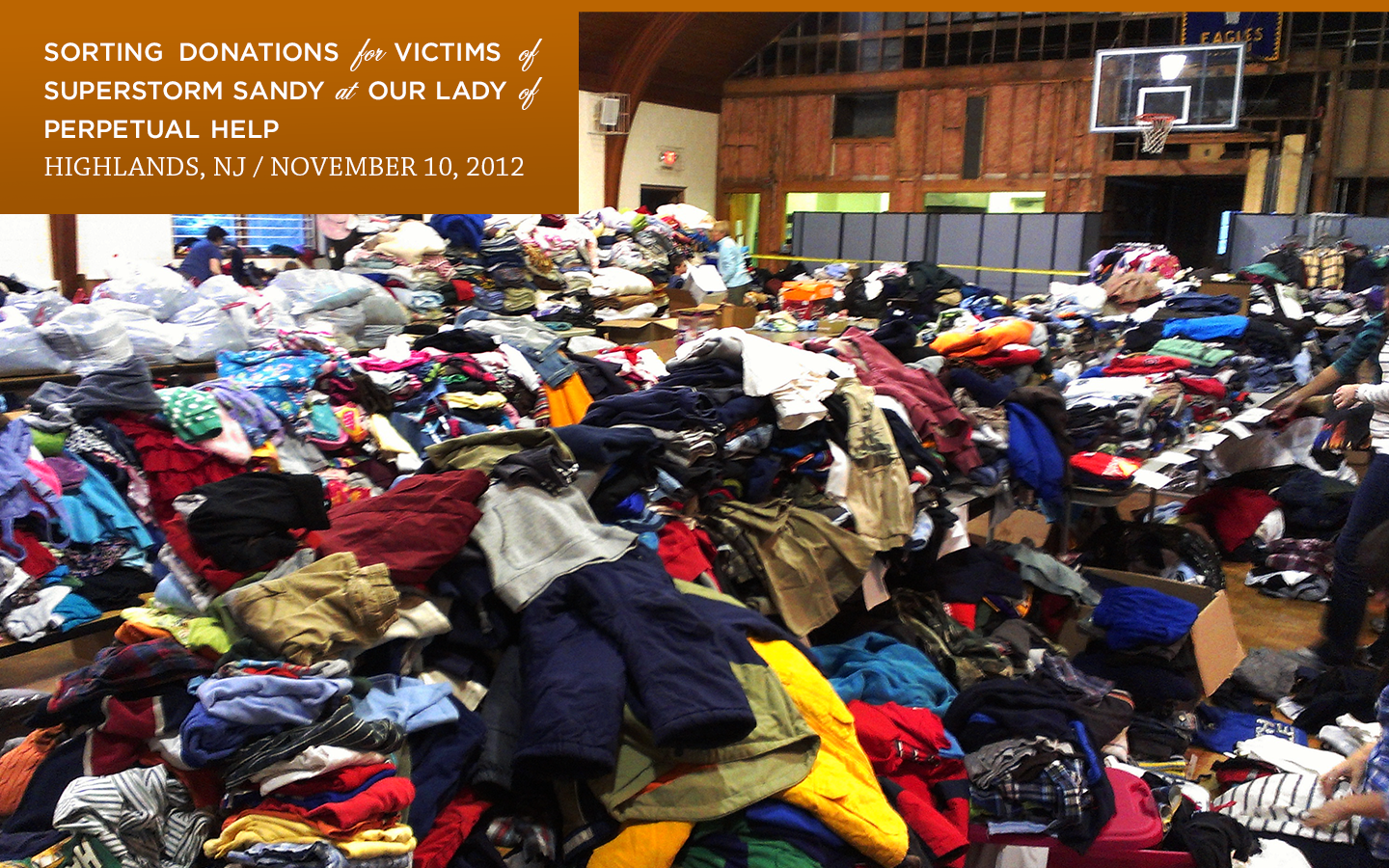
Here’s the thing: Superstorm Sandy was water, wind and motion; it was convergence; it was what happens when climate systems come together and collaborate to make the unbelievable happen. The hybrid superstorm altered the entire calculus of local and national government across a region. Our priorities were altered, and many lives will never be the same. The frailty, the vanity, the ephemeral nature of our built environment, came into stark contrast.

There are important ways in which Sandy makes us see what we might not otherwise have noticed:

  • In New York City, for instance, it is now clear that gas stations can sell more gas during a crisis of this magnitude, if they have gas-powered generators to back up their electricity supply.
  • The value of maintenance—especially with respect to 1) transport infrastructure, 2) electric grid infrastructure, 3) mobile communications redundancy, 4) building service supply infrastructure (heat, hot water, electric)—cannot be overestimated.
  • Preparedness Matters.
  • Electrified water not only starts fires and can consume neighborhoods; it kills on contact.
  • As the Roman stoic philosopher Epictetus always already knew: there are certain factors involved in our experience over which we have little to no control; knowing which are which can be a matter of life and death.
  • Tunnels can and will flood; tunnels can and should be sealed in case of flood emergency.
  • Building the electric transport future means we need to build more resilient electric power delivery systems, with more layers of redundancy, more localized generation, more flexible power sourcing.
  • It turns out people want to help people and will do so when motivated—by Mother Nature, by the needs of others, by conscience and by the example of others.

We find that people are the ones who labor to help people. While the natural order puts fragile human lives on the line, and ideologically motivated or materially focused politicians quibble over process and pet peeves and secret deals, ordinary people come to the rescue of ordinary people.

One of the greatest stories of the Superstorm Sandy saga has been the volunteer work. Specifically:

  • Occupy Sandy has arisen as a new operation for the original Occupy Wall Street media outlets, which have been used to not only locate and share information about hotspots of serious need, but also to organize spontaneous pools of volunteers.
  • Volunteers from the Gulf Coast have come with supplies, expertise and open hearts, telling anyone who will listen that they recall the eagerness and aplomb with which volunteers from the northeast rushed to the Gulf to help after Hurricane Katrina and the BP oil spill; even members of Congress have vowed to reinforce that grassroots inter-regional partnership among citizens and communities.
  • People taking interest in their communities are helping to inform the city, state and federal governments, along with utilities and emergency workers, where to go and what to do to maximize or optimize their impact on disaster relief.

The state of New York is now asking for a $30 billion supplemental spending package to help New York City and Long Island recover from the disaster and “harden” the built environment against extreme weather events. Something is happening to the climate, and it is threatening to undermine the normal functioning of civilization as we have known it. Public authorities are waking up, and citizens are demanding government that works.

New Jersey’s governor even talks about raising taxes to pay for disaster relief and future preparedness.

Today’s Republican Party Cannot Save Itself

The national strategic and organizing structure of the Republican Party cannot save itself. It has become functionally obsolete. The strategy adopted two generations ago—whereby the Republican Party essentially bet everything on the perceived reliability and uniformity of the white male vote—is no longer a serious strategy, no matter how cynical your point of view. The party needs a dramatic infusion of new ideas, more moderate thinkers and genuinely centrist strategy.

A combination of demographic shifts and Republican radicalism has allowed the Democratic Party to hold both the far left and the broad center of the American political spectrum. There are a number of Democratic members of the House and the Senate who are more conservative than many Reagan-era Republicans. A sclerotic adherence to ideological dogma, in many cases without any foundation in the historical or economic record, has led GOP leadership to disavow even those Democrats who could help make a more moderate GOP relevant.

Continue Reading

About State-level Healthcare Reform Benefits

If your state is run by one of those Republican governors who is still refusing to participate in any way in the implementation of the Affordable Care Act’s state-level health insurance exchanges, here’s what you need to know: not participating makes the implementation more expensive, not less; not participating surrenders state control to the federal government, not the other way around. If your governor is refusing to participate in the creation of your state’s health insurance exchange, your governor is sabotaging your state’s sovereignty in service of a pointless ideological tantrum.

And that matters, to you, whether you know it or not.

Some states will have real market reform, and the state-level authorities will be actively involved in that reform, representing their constituents and steering the process of reform in a way that is most affordable, and helpful, given the lay of the land and the unique circumstances people face in communities across that state. This cannot be said of those states where ideologically captive governors abdicate their responsibility and invite the federal government to do all of the heavy lifting.

Continue Reading

Future Voting: Free, Fair, Efficient

We need to admit two things about elections: first, they need to be 100% citizen-centered; second, citizens need to go the extra mile whenever necessary to make elections work. The first point is about legitimacy; the second is about making sure we can have it, given the imperfection of all systems known to date. Every since the year 2000, in the United States, there has been evidence that our voting systems are not 100% secure, efficient and legitimate.

The third thing we need to say about elections is that they really do decide, to some degree, the future. All elections are future elections, and all elections should live up to that responsibility. We can build a better system, if we prioritize:

  • 100% accuracy in capturing votes
  • voter-verified redundancy (a paper trail)
  • inviolable ballot security
  • 100% voter access to vote
  • rapid, reliably error-free count

Continue Reading

Independents Say: Centrist Pragmatic Progressivism to Solve Nation’s Ills

The election of Barack Obama to the presidency, in 2008, was the result of a broad coalition of voters, from not only the Democratic base and liberal independents, but also centrist independents and moderate Republicans. Some conservatives joined the coalition, because they believed Obama was more forthright and trustworthy. In 2012, we now see again the strength of the independent voters’ collective demand for more creative, collaborative government, oriented toward pragmatic problem solving, honoring our democratic values, and restoring dignity to our politics and our communities.

That is why GOP operatives are now locked in a vicious struggle with Tea Party radicals, for control of the party. It is why both moderates and conservatives are right to characterize Karl Rove’s SuperPAC shenanigans as “incompetent” and “counterproductive”. It is clear that the libel-focused billionaire-backed campaign only served to inspire and harden support for Pres. Obama.

Continue Reading

Two-party System: Envelope Pushed to Limit?

New coalitions are needed, to do the work we need done.

It is time to take a hard look in the mirror once again. Our democracy is an indirect democracy, so much so that we don’t even vote directly for our preferred candidates for president and vice president; we vote for the slate of “electors” who will in turn cast votes for them. In 2000, we saw the tremendous flaws inherent in this process and how it was originally designed to ensure “the mob” would not rule. The Senate was originally not chosen by the people at all. The mechanism for removing corrupt or ideologically biased Supreme Court justices is virtually non-existent, though it does, in theory, exist.

We can, through the House of Representatives, have more or less “direct” access to our elected representatives, and at lower levels of government, citizen involvement is not only eminently possible, and fairly commonplace, but urgently necessary. As Pres. Obama said on election night, this year: “America has never been about what can be done for us. It’s about what can be done by us, together, through the hard and frustrating but necessary work of self-government. That’s the principle we were founded on.”

Self government is not easy; indeed, it is “hard and frustrating”, and “necessary”, if we are to have anything like a just society with a legitimate form of civilian rule. Democracy is not for the faint of heart, but it is for all of us. And, when we look in the mirror, in the year 2012, we can see that the two-party duopoly does not adequately express the aspirations, concerns, demands and creative collaborative potential of the American people. All too often, the choice between the parties seems to be a choice to counter the vices and inadequacies of the party that has been governing. Instead of the aspirational politics exemplified by the unique phenomenon of Obama’s two campaigns, we normally have something like the most reductive form of a constructive experiment in the peaceful transition of power.

In 2006, Democrats swept to power amid revelations of rampant corruption in the Republican-controlled House of Representatives. In 2008, a relative newcomer to the United States Senate, Barack Obama built a campaign of more than 13 million supporters and participants, an online network bigger than either party itself, secured record numbers of donations from record numbers of “small donors”, amounting to a record overall campaign warchest. The national passion for this de facto third party challenger to the inertia of the duopoly won him nearly 70 million votes, far more than any candidate in US history.

The response from Senate minority leader Mitch McConnell, a Kentucky Republican, was to organize every action any member of his caucus would take, for the next four years, around the singular purpose of “destroying the Obama presidency”. (One might argue McConnell and his gang of pirates—the meaning of “filibuster” refers to 17th- and 18th-century piracy in the Mediterranean—have now forfeited all credibility, having sworn themselves to the sabotage of the American experience, for the sole purpose of getting rid of the most widely supported US president in history, but no one seems to be making that case, at the moment.)

In 2010, a billionaire-funded “astroturf” movement calling itself “the Tea Party” made an attempt to take over the Republican party, posing as populists but with an agenda to hand control of the party irreversibly to big business interests. Low voter turnout and a surge of populist fervor on the right, swept the Republicans back to power in the House of Representatives. The result has been “divided government” of a kind that is not only sclerotic and vitriolic, but unbelievably counterproductive and corrosive to American democracy.

Bipartisanship has been cast by Republicans as a betrayal on a par with treason, and campaign literature has consistently shown a reluctance to move toward any less emotionally unstable conceptualization of democracy. Hysteria and propaganda have replaced constructive problem-solving as first-order priorities for too many of our public officials. Part of the reason for that is the very real and warranted fear that the other side will, inevitably, regain power, at some point. Coalition-building is not rewarded as much as it should be in an open democracy.

On election night, this year, Republican strategists, from moderates through to fiscal and even social conservatives, spoke surprisingly openly about the party’s existential peril, going forward. If the Republican party wants to remain “a national party”, said Steve Schmidt, top adviser to the McCain campaign in 2008, it will need to diversify. The Romney campaign should be, he and others argued, the last Republican campaign that bets the farm on thinly veiled white supremacist language and the language of patriarchy and opposition to the rights of women and immigrants.

As the Republican party’s market appeal shrinks, necessarily, and the vote of young people, women and minority groups, expands, the party has two choices: moderate the extremist discourse that has been dominating the party’s national agenda or be relegated to the right-wing fringe. So far, the party has held off this inevitable reckoning with a hysterical cry against “socialist” domination of the American political system—and by socialist, they mean Democratic.

But that will only work for so long. The Democratic party is not a socialist party, and its way of creating, funding, maintaining and improving social service systems is decidedly more democratic and grassroots-focused than any European socialist system. The system of social services we have was largely created by the Democratic party, and so a moderate Democratic party—which is what we have—now sits astride the political center, more genuinely conservative on many issues than the Republican radicals calling for “2nd Amendment options” against the system we as a nation have established by way of democratic process.

As the Republican party shifts more and more to the right, the Democratic party is freed to take over more and more of the political center, and it has done so. The United States Senate and the House of Representatives both include Democratic members that are more conservative than most Republican presidents of the 20th century, even some more conservative than George W. Bush and Mitt Romney. And of course there are real liberals, unapologetically committed to the social agenda of human liberation and civil rights.

The Democratic party is positioned to own the system for a generation, if the other half of the duopoly falters. And it has faltered. In 2012, the Republican party was unable to muster even a single credible presidential candidate. Mitt Romney was never trusted by the American people, and his naming of Paul Ryan to the ticket was a weak-kneed attempt to appear serious on a single issue, where his party has been unable to propose any constructive solutions.

The Republican campaign flailed back and forth, desperately, from extremist Randian anti-Christian feudalism to pro-plutocracy to arbitrarily applied Christian fundamentalism, to grasping at straws on taxes, social policy, immigration, jobs and the environment. The Republican party campaign apparatus became a lie factory, spending over a billion dollars on absurd claims, not supported by facts, and which did not produce in the minds of voters even one clear, coherent message about actual policy planning.

Nate Silver was right to put the odds of Obama’s re-election as over 70%, then over 80%, and eventually over 90%, as it became clear that voters did not like Romney, did not trust Romney, did not support eliminating Medicare—virtually the only policy plan publicly stated by the campaign—, and did not believe they would ever know enough about Romney in order to believe he was on their side. Even Republicans consistently shared such feelings with pollsters and the press.

So, this week the political press is awash in talk about Obama’s great “coalition”, bringing together minority groups, social interest groups, the traditional Democratic “base” and even “smart money”—the kind of affluent political thinkers who understand they actually do better in a more equitable economy, led by a Democratic president, than they do in a laissez-faire economy where consumers are poorer and poorer over time. But what coalition exists to rival that new center-left? At present: none.

But for some time, it has been evident that there is a natural, if awkward, affinity between the Green Party and the Libertarian Party and the grassroots movements they aspire to represent. Both favor genuine liberation of the individual in civil rights and jurisprudence; both favor a ground-up democracy, not a top-down democracy; both favor participatory consensus-building over party committee rule. Both have a genuine appeal to make to middle class voters, on the potential of crafting policies that will humanize government, build quality of life for communities and rationalize our politics.

As the shift away from the old Republican way continues, the Republican party will have one crucial decision to make that will affect us all: will it moderate its discourse, open its doors to newcomers, embrace constructive pragmatic problem solving and socially viable 21st century individual and community liberation, or will it continue to move to the extremist fringe? If it comes back to the world the rest of us inhabit, the two party system might go on for some time.

If it does not, a Green-Libertarian grassroots alliance will be poised to assimilate the most intelligent and constructive voices from the Occupy movement, even the Tea Party grassroots, and certainly from committed independents, and might have enough appeal, over the next few election cycles, to become the 2nd party nationally by 2020. The rise of Barack Obama illustrated perfectly how a true insurgent, more focused on letting the voices of his supporters emerge from the background noise, can rapidly replace the old guard, when democracy comes to its truer expression.

Look now for opportunities to bridge the divide between Libertarians and Greens. Look now for opportunities to build grassroots coalitions that will influence or replace out-of-date partisans, starting at the local level. Look for opportunities like the Senate campaign of Bill Barron, in Utah—a principled independent running to restore genuine thinking about life at the human scale to our discussion about environment, energy, economics and industry. Look for ways to find your voice within the fabric of our “hard and frustrating, but necessary” democratic process for making public policy and law.

2012 is not a “mandate” for divided government; it is a reminder that we need a more thoughtful political system, where creative collaborative problem-solving is the norm, not the critically endangered species. The new era of constructive coalition-building starts now.

New Jersey Special Voting Process Irregularities

After telling the people of New Jersey they would be able to vote in today’s election, in spite of severe impacts from hurricane Sandy, Gov. Chris Christie’s administration appears not to have taken adequate measures to support the new voting options promised. There are reports of downed servers blocking email applications for mail-in ballots, while county clerks responsible for responding appear not to be making needed information available to voters.

Ever suspicious of am arch-rival’s intentions, some progressives appear yo believe Gov. Christie intended the email ballot request process to be a trap, designed to disenfranchise voters, since New Jersey law in non-emergency situations forbids voting at polling stations once the request for a mail-on ballot has been sent.

My own personal experience supports anecdotal reports of blocked or overloaded processing at the county level. A request, with completed application, sent to the Monmouth County Clerk’s office has received no response at all… not even an automated email response to let me know the application had been received. Only one phone number associated with the County yielded a human voice. The kind woman knew nothing about what would happen, but had been told to give out two numbers which are not even in service—or, which are in service, but so overloaded, no one can get through and they automatically disconnect.

Continue Reading

No more posts.