The Drivers of National Debt

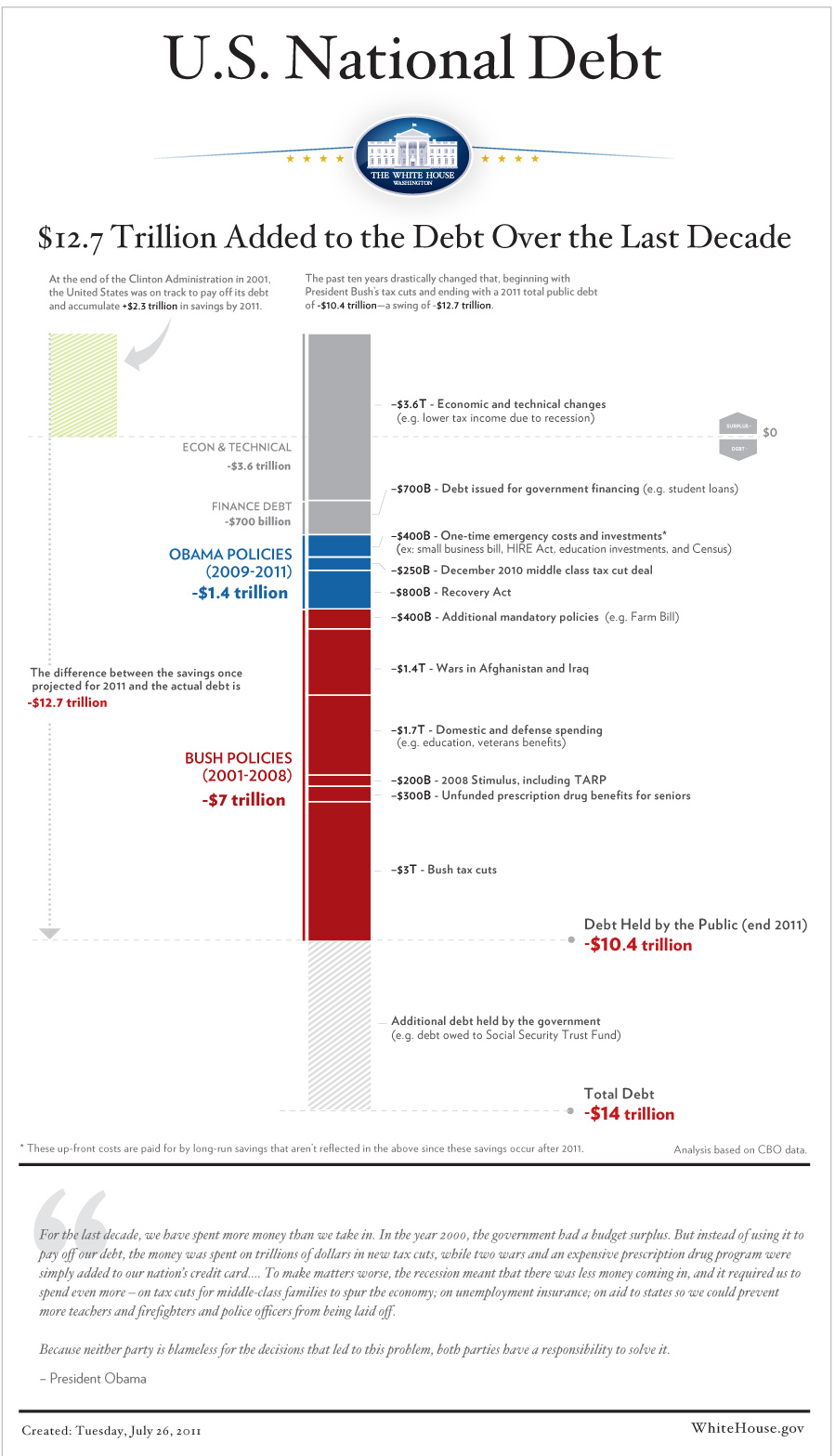
The composition of the national debt is a complex history of policy decisions, governmental priorities and Congressional authorizations. Republican opponents of Pres. Obama have suggested that debt and deficits have “exploded” since he took office. They have sought to paint the president as a “tax and spend liberal”, because that accusation fits their standard campaign model.

Continue Reading

Let’s Build Something

The US economy is struggling to fully emerge from the Great Recession. Even as Wall Street barons and multinational corporations rake in record profits, job-creation is still slow, and credit is tight for most people and most businesses. It is time to start capital flowing by actually building something new, which just happens to be a necessary step toward building a better, more prosperous future.

The American Society of Civil Engineers warns that if we continue to fail to maintain and upgrade our decaying infrastructure, we will see economic output depressed by $3.1 trillion over ten years, and lose over 800,000 jobs. Opportunity costs could be still higher, and some economists believe we have literally millions fewer jobs today than we would were we to invest seriously in infrastructure.

Continue Reading

Boehner Stands Alone between Reason and Unreason

House Speaker John Boehner appears to be under attack from an intransigent House Republican caucus that will not allow him to retain any credible leadership if he agrees to a debt and deficit reduction plan that includes any tax increases of any kind. While select Republicans in the Senate agree with the deficit commission recommendations and the Gang of Six proposal—which recognizes the need to increase revenues to deal with escalating deficits—, radicals refuse to agree to any compromise.

It seems Speaker Boehner is being held hostage by a radical Tea Party revolt in his party, whom he is not prepared to anger. Part of the problem is rhetorical. On issues of debt, deficit, entitlements and security, routine use of hyperbole has so distorted debate, that much political discourse now distorts what is actually happening in policy. Republican Sen. Tom Coburn (OK) told Meet the Press, falsely, that “the government is twice as big as it was ten years ago; it’s thirty percent bigger than it was when Pres. Obama took office.”

Continue Reading

Default Means 44% of Bills Unpaid, 10% Decline in GDP

The Bipartisan Policy Center has found that if there is no agreement to raise the debt limit by August 2, the Treasury Department would fail to pay 44 percent of its obligations. That 44 percent of government spending, over a year, is equivalent to a real decline in GDP of 10 percent.

The number is that high because the Treasury Department has been making fiscal adjustments since March, in order to stave off default. Those adjustment have been pushed as far as possible and cannot continue to push back the deadline, beyond August 2.

Continue Reading

Why We Should Have a National Infrastructure Bank

There are competing theories about what makes for good economic stimulus, and there are practices that work well and which don’t work very well. We know that tax cuts are not very stimulative, because they take a long time to show up in people’s bank accounts, and they are comprised of money that was already there to begin with. New money, extra money, is more stimulative. So food stamps, for instance, can return 70% to 100% gain in stimulus, above and beyond cost.

But we aren’t looking to fix the long recovery by using food stamps for stimulus. And we can’t really do any tax cuts that would help to expand GDP. If we want to spur a more vibrant recovery, we have to find a way to put new money, extra money, in people’s pockets, and it has to be more than they need to meet the ever-rising costs of living. It makes sense, then, that intelligent investment in high-growth activities would be the best way to make that happen.

Continue Reading

Not Every American “Owes” the Same on the National Debt

The House majority leader Eric Cantor (R-VA) recently published an op-ed, in which he argued that “If Washington actually had the discipline to live within its means over the long term, every American citizen would not owe $46,000 toward the national debt.” The rhetoric is effective, but the logic is flawed; not every American “owes” an equal share of the national debt.

The national debt is what the federal government owes in long-term interest on government-backed bonds, Treasury bonds. Long-term Treasury bonds pay out over several decades, and have (thanks to the high credit rating of the United States government) a very low rate of interest. The bonds are used to finance spending in the short term for which there are no sufficient tax revenues in reserve.

Continue Reading

Once World-leading Infrastructure in Decay: the Road to Recovery

The road to economic recovery must run through major new infrastructure upgrades, innovation and development. The American infrastructure was once the envy of the world, a valiant testament to the ingenuity and collaborative muscle of a free people; now, it is crumbling [pdf] from malignant neglect, and the cynicism of our political system’s dealings with money.

Infrastructure spending was once part of the central mission of building a great nation, open to trade and competition, where free people would migrate, ship, travel and explore, according to their own free will, imagination, and opportunity. Now, that embarrassment of riches is little more than embarrassment, and the resulting confusion over how we let such a vibrant landscape slide so far.

Continue Reading

The Severe Economic Danger of Replacing Medicare with Vouchers

The so-called “Ryan budget plan” —as recently as last year considered a radical, fringe proposal, even by top Republicans, but in 2011 approved by the Republican House majority as their official legislative plan for the nation’s fiscal policy— calls for eliminating Medicare and replacing it with a system of vouchers to lower the cost of buying private insurance.

The plan has already stirred a nationwide revolt in public opinion against the new Republican majority, and turned one Congressional district, not lost by the party in over a century, decidedly Democratic, despite the disproportionately Republican makeup of the interim electorate. But the ire of seniors and the non-affluent generally is just one of the perils of the plan.

Continue Reading

To Create Jobs, Innovate; Don’t Favor the Least Imaginative

We will not fall magically into a rising tide of job creation, just by depriving ourselves of services and privileges we have built into our way of life and on which our prosperity depends. And we will not create jobs by privileging those industries that are doing the least to innovate. Innovation is the American way; it is what the nation has always struggled to accomplish, and it must be the cornerstone of a new job-creation boom.

It may be that moments of grave economic pressure put grave strain on a culture’s ability to give voice to and to share a common understanding of core values. It may be that after the financial collapse that struck in 2007 and 2008, the US is facing a crisis of conscience and a struggle to regain its identity. We need to remember that we can take the reins of the 21st century economic landscape, and build the economy of tomorrow.

Continue Reading

Fossil Energy: Hidden Costs Threaten America’s Future

As civilization evolves, and science advances, and democracy effects positive change in favor of human dignity and freedom, one paradigm replaces another, and we become better at managing the problems that threaten to destabilize the human environment. There was a time when authority could use command and control to maintain order, for a time, but in our democratic and informational age, that paradigm is as primitive and unworkable as it is unjust, and our problems demand subtler, more values-infused solutions.

As the subtitle of a recent Economist report on closed industries in Italy says it, “Cartels that make life cushy for insiders exact a heavy toll on everyone else”. There is no real way around this: to profit from doing business well and providing excellent quality of manufacture and service is one thing; to pad one’s profits by coordinating market strategies with close competitors that join with one to form an exclusive cartel, boxing out the influence of stakeholders is quite another.

Continue Reading

No more posts.