We are All Now Safer in our Freedom

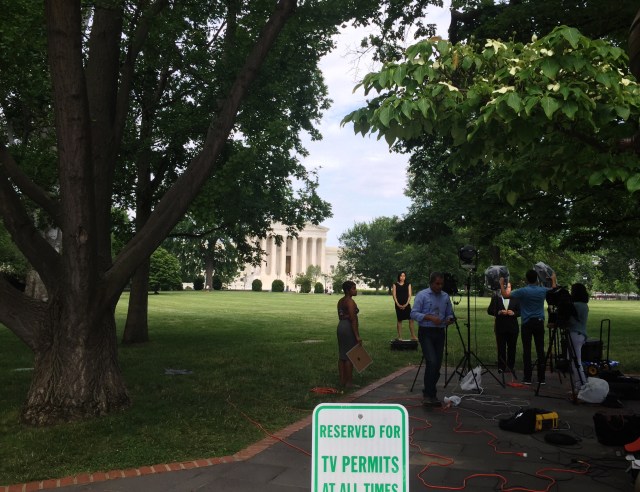
On the morning of June 26, 2015, the Supreme Court ruled that same-sex marriage is a basic right, across the United States. The ruling in the case known by the name Obergefell v. Hodges was 5 to 4, showing a tightly split Court, but effectively invalidating all bans on same-sex marriage, whether brought into effect by legislation, referendum, executive order or lower court rulings. 

Here’s why this is good for people of all political and religious persuasions: 

Continue Reading

How Citizens can Catalyze Climate Action

On June 5—World Environment Day—we held a press conference to announce CCL’s effort, through the Pathway to Paris project, in collaboration with the World We Want, to build a worldwide always-active Citizens’ Climate Engagement Network. The press conference was conducted in association with the Climate Matters video interview series, as well as COY11, CliMates, IAAI GloCha, Context News, and the Association Actions Vitales pour le Developpement Durable.

Continue Reading

Quiet Revolt Stuns UK Pollsters

For weeks, public opinion polls in the UK have shown the contest for leadership of the UK government to be a dead heat, likely to require a complicated negotiation to achieve a new governing coalition. Nearly every poll showed the Conservatives and Labour to be hovering around 34 percent support each. No one was expected to win an outright majority. Late last night, however, exit polls showed something radically different: David Cameron’s Conservatives beat Labour 37 to 31 in the popular vote, and would hold an outright majority in Parliament, while the Scottish National Party won nearly every seat in Scotland.

Continue Reading

Disruptive Optimism for Serious Change

We need non-expert voices in the room. No individual expert knows everything, many decision-makers are themselves non-experts, and considering stakeholders’ voices leads to more legitimate, relevant and viable policy outcomes. Significant improvements in the prevailing condition require disruption of the status quo. The status quo implicitly extends from the status quo ante, the prevailing norms that preceded the current state of affairs and on which the structures we know were founded. Expertise is rooted in an examination of these two states, and can provide a sound and reasoned reference for how to move into the future, but when we look to achieve a post status quo reality, where human conditions are greatly improved and the previously unavailable has become commonplace, we have to recognize that we are looking beyond what is known. Expertise unaccompanied by the power of imagination and a hot contest of ideas can lead to planning not well adapted to visualizing, comprehending or catalyzing disruptive optimizing change.

Continue Reading

GOOD-based Economics: How to Build the Middle Class

Our political system is not, strictly, a macroeconomic guidance machine; political leaders have a lot of responsibilities that take day-to-day precedence over direct macroeconomic maneuvering. Stewardship of our civic infrastructure can provide direct benefits to citizens, communities, and enterprise, and so our analysis of how well our policy choices work to motivate real macroeconomic health and improvement needs to consider those other values.

We all know, from one perspective or another, how ideological preferences influence what one analyst or another might refer to as “just the numbers”; this is one of the main reasons there is such heated disagreement about whose policy preferences do better at creating value for households, communities, and enterprise. By adding to our value considerations a G.O.O.D. economic analysis, we can better see the generative capacity of a given policy priority, economic trend, or technical innovation.

Continue Reading

Common Sense Demands Collaboration

The word politics comes from polis, the Greek word for city, or state. Politics is the art of living amongst people. It is, at the root, and in practice, a project of collaborative problem-solving. In its broadest sense, it is a way to describe our process of learning how to talk about value with those around us; it is the study of what happens when people make choices, relying on free will and individual expression. Cynics, with either too much or too little immediate access to power, often argue there can be no real freedom and little cause for faith in humanity. That has never been the case. We constantly exercise our power of observation, our judgment, and our freedom to choose; this is how we relate to every person we know. In this sense, politics is what Jacques Derrida referred to as peri-philías: an examination of the nature of friendship. We form affinities, friendships, families, communities, alliances; we apply our vision, our judgment, our imaginations, and our best use of shared language, to hold the world together. It is to our benefit that choices lead to consequence, so we can choose better, improve outcomes, redress our failings. The question is: Do we build on each other’s strengths?

Continue Reading

Citizens Engage World Governments in Lima

The 20th Conference of the Parties, held in Lima last month, produced a consensus agreement among 195 governments, which provides the draft structure for “an agreed outcome with legal force” to be finalized in Paris, in December 2015. During the Lima Conference, governments engaged each other, non-governmental organizations engaged the process, and through Citizens’ Climate Lobby and the Pathway to Paris project, I had the privilege of helping to bring the voices of citizens from around the world directly into the process.

Continue Reading

Respect is a Catalyst for Success

Politics is hard. Making policy that appeals to a wide range of political actors, stakeholders, and related interests, is by some people’s estimation functionally impossible. But at the heart of every legitimate political endeavor, there is the core insight that in its most expansive sense, what is of real interest to humanity anywhere is of real interest to humanity everywhere. We are connected by certain shared truths. We require certain sustenance to facilitate our survival, and we are all vulnerable to the forces of nature and of human violence. We have a transcendent, reciprocal interest in humane policy processes that protect life-giving systems. Working with people of all views and from around the world, on something as complex as climate, I have witnessed firsthand to what degree respect is the most effective strategy for building up the possibility of effective outcomes.

Continue Reading

Overcoming the Dissociation Crisis

A report on the Global Online Policy Forum: Solutions from Crisis, from the Pathway to Paris project…

Systems thinking views systems as already containing the expression of their own virtues and their own failings. A system cannot fail, unless the failure is made possible by some component of the system. In our use of energy, in contact with the Earth’s climate system, there is a flaw: our system is not designed to maintain a reliable climate-energy balance. So, we are pushing past the limits of the system, and motivating/encountering disruption. If we understand this, we can better see our limits, understand our strengths, and leverage the virtues of the system to achieve an outcome conducive to human thriving.

Continue Reading

When Citizens are Involved, Lawmakers Respond

The people have a right to co-create policy with our representatives.

Political analysts around the world have been noting the extreme negative tone of the 2014 midterm election campaign in the U.S. Outside groups that are spending hundreds of millions of dollars on smears and innuendo are degrading the political debate. The ugliness of the campaign has exacerbated the bitterness many Americans feel toward the political process itself.

That bitterness tends to be connected to a feeling of detachment or of access denied. People believe they do not have access to their elected officials and that the parties do not respond to their day-to-day needs. This detachment is driven partly by the apparent inability of leading national political figures to work together, which leaves a great deal of important work unfinished.

Continue Reading

No more posts.