Big Ideas to Solve the Debt Crisis & Restore the Middle Class

The debt crisis is attributable to “structural” causes, meaning the way the nation’s financing is structured over the next several decades, but also to political and economic causes, meaning both the way we make policy and the way we live and experience the marketplace for trade, credit and consumer purchases. So, we need to implement policies that make serious, sustainable corrections on all three fronts.

Stabilizing debt financing requires the least expensive cost of borrowing possible, i.e. a AAA credit rating and the reputation for 100% likelihood of on-time repayment. It is unhelpful and counterproductive to indicate that the US might not meet 100% of its obligations on time 100% of the time. The long-term solution has to be oriented toward making social services solvent, and reducing the costs of debt repayment.

Continue Reading

The Republican Candidates Debate in Iowa – A Full Report

Most of the Republican candidates for their party’s presidential nomination debated last night in Iowa, two days ahead of the crucial Ames Straw Poll, thought to be a leading indicator of which candidates are credible and which are less likely to win in January. Rick Perry, who has not yet announced his candidacy, was not in attendance, and Fred Karger—who met all the criteria for attendance—was not allowed to participate, some say because he is openly gay.

The questions were direct, tough and probing. Challenged on her claim that she could turn the US economy around in just three months, Michelle Bachmann fielded the first of many tough questions. She backtracked somewhat, claiming that she could not fix the economy in three months, but that she could enact policies that could eventually have a positive impact. She then trailed off into a “one term president” rant against Obama, which opened her to the critique that her policy plans lack substance.

Continue Reading

Toward a Creative Prosperity Agenda

creative prosperity is sustainable prosperity

To build a future of vibrant open democracy and robust and sustainable economic prosperity, it is necessary to privilege creative activities and constructive solutions to the challenges we face. Addressing major challenges in constructive, innovative ways, is the single most significant driver, historically, of sustained economic booms. In short, we need to move deliberately and swiftly toward a creative prosperity agenda.

The first consideration, then, is to examine how the creative prosperity agenda would differ from what we are doing now. At present, we are wrestling with the complex fabric of consequence related to long-running economic distortions, most of which we have not yet corrected. Healthcare reform and financial regulatory reform were comprehensive in scope, but moderate in impact, cautious and rooted in the prevailing model; energy reform needs to move forward rapidly and do more to prioritize innovation.

Continue Reading

What’s Wrong with the Stock Market?

What’s wrong with the stock market, particularly the New York Stock Exchange and the Dow Jones Industrial Average? The most significant problem facing the stock market is really a confluence of two problems: 1) we have too little middle class wealth, and so too little consumer demand, and 2) we face an urgent need to accelerate the transition to a new economy, but we are focused on trying to revive an old economy.

On Thursday, August 4, the Dow Jones Industrial Average dropped almost 513 points, losing 4.3% of its total value, the worst one-day decline since December 2008, and an effective reversal of 8 months’ worth of gains. It happened two days after the United States avoided a default by raising the debt ceiling and cutting government spending by about $250 billion per year over the next 10 years.

Continue Reading

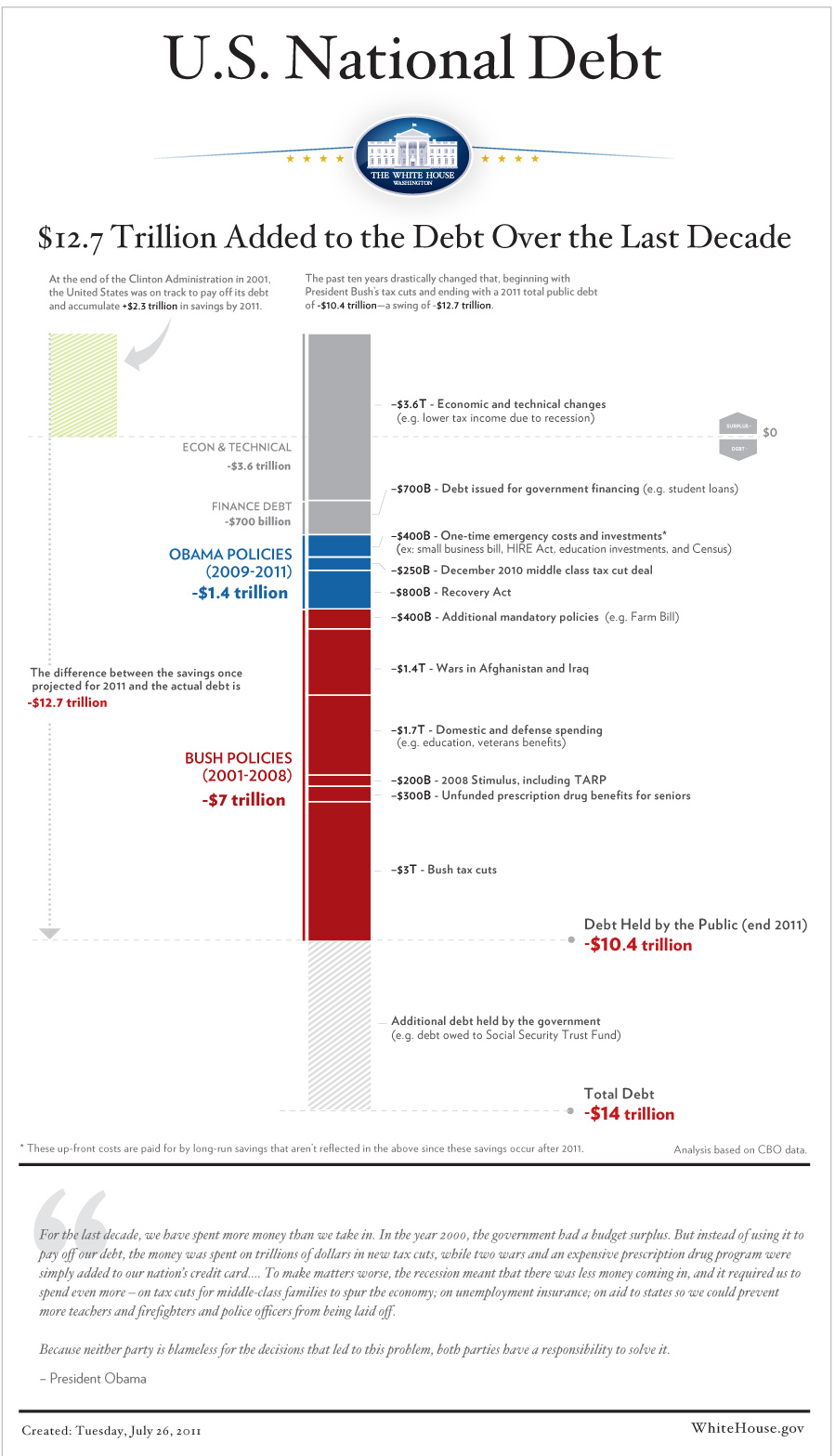
The Drivers of National Debt

The composition of the national debt is a complex history of policy decisions, governmental priorities and Congressional authorizations. Republican opponents of Pres. Obama have suggested that debt and deficits have “exploded” since he took office. They have sought to paint the president as a “tax and spend liberal”, because that accusation fits their standard campaign model.

Continue Reading

Let’s Build Something

The US economy is struggling to fully emerge from the Great Recession. Even as Wall Street barons and multinational corporations rake in record profits, job-creation is still slow, and credit is tight for most people and most businesses. It is time to start capital flowing by actually building something new, which just happens to be a necessary step toward building a better, more prosperous future.

The American Society of Civil Engineers warns that if we continue to fail to maintain and upgrade our decaying infrastructure, we will see economic output depressed by $3.1 trillion over ten years, and lose over 800,000 jobs. Opportunity costs could be still higher, and some economists believe we have literally millions fewer jobs today than we would were we to invest seriously in infrastructure.

Continue Reading

Boehner Stands Alone between Reason and Unreason

House Speaker John Boehner appears to be under attack from an intransigent House Republican caucus that will not allow him to retain any credible leadership if he agrees to a debt and deficit reduction plan that includes any tax increases of any kind. While select Republicans in the Senate agree with the deficit commission recommendations and the Gang of Six proposal—which recognizes the need to increase revenues to deal with escalating deficits—, radicals refuse to agree to any compromise.

It seems Speaker Boehner is being held hostage by a radical Tea Party revolt in his party, whom he is not prepared to anger. Part of the problem is rhetorical. On issues of debt, deficit, entitlements and security, routine use of hyperbole has so distorted debate, that much political discourse now distorts what is actually happening in policy. Republican Sen. Tom Coburn (OK) told Meet the Press, falsely, that “the government is twice as big as it was ten years ago; it’s thirty percent bigger than it was when Pres. Obama took office.”

Continue Reading

Default Means 44% of Bills Unpaid, 10% Decline in GDP

The Bipartisan Policy Center has found that if there is no agreement to raise the debt limit by August 2, the Treasury Department would fail to pay 44 percent of its obligations. That 44 percent of government spending, over a year, is equivalent to a real decline in GDP of 10 percent.

The number is that high because the Treasury Department has been making fiscal adjustments since March, in order to stave off default. Those adjustment have been pushed as far as possible and cannot continue to push back the deadline, beyond August 2.

Continue Reading

Why We Should Have a National Infrastructure Bank

There are competing theories about what makes for good economic stimulus, and there are practices that work well and which don’t work very well. We know that tax cuts are not very stimulative, because they take a long time to show up in people’s bank accounts, and they are comprised of money that was already there to begin with. New money, extra money, is more stimulative. So food stamps, for instance, can return 70% to 100% gain in stimulus, above and beyond cost.

But we aren’t looking to fix the long recovery by using food stamps for stimulus. And we can’t really do any tax cuts that would help to expand GDP. If we want to spur a more vibrant recovery, we have to find a way to put new money, extra money, in people’s pockets, and it has to be more than they need to meet the ever-rising costs of living. It makes sense, then, that intelligent investment in high-growth activities would be the best way to make that happen.

Continue Reading

Not Every American “Owes” the Same on the National Debt

The House majority leader Eric Cantor (R-VA) recently published an op-ed, in which he argued that “If Washington actually had the discipline to live within its means over the long term, every American citizen would not owe $46,000 toward the national debt.” The rhetoric is effective, but the logic is flawed; not every American “owes” an equal share of the national debt.

The national debt is what the federal government owes in long-term interest on government-backed bonds, Treasury bonds. Long-term Treasury bonds pay out over several decades, and have (thanks to the high credit rating of the United States government) a very low rate of interest. The bonds are used to finance spending in the short term for which there are no sufficient tax revenues in reserve.

Continue Reading

No more posts.